Why the Arizona Heat is Your AC's Worst Enemy
Champion Air
Discover what shortens AC lifespan in Arizona: dust storms, UV damage, hard water & heat. Extend yours with expert tips!
Why Arizona's Climate Is Destroying Your AC Faster Than You Think
What shortens AC lifespan in Arizona is a combination of factors that simply don't exist at the same intensity anywhere else in the country. While a central air conditioning system typically lasts 15 to 20 years in most U.S. climates, the same unit in the Phoenix Valley often fails after just 8 to 12 years — sometimes sooner.
Here's a quick breakdown of the main culprits:
- Extreme heat — Temperatures regularly exceed 105°F for months, forcing your system to run 10 to 16 hours per day
- No nighttime recovery — Phoenix nights frequently stay above 90°F, so your AC never gets a true rest
- Dust and haboobs — Desert dust storms clog condenser coils and grind away at motors and fan blades
- Attic temperatures — Indoor units and ductwork bake in attics that can reach 140 to 160°F
- UV radiation — Intense sun degrades plastic components, wiring insulation, and outdoor unit materials
- Improper sizing or installation — A unit that's too big or too small burns through components far faster
- Neglected maintenance — Skipping tune-ups in Arizona's conditions is far more costly than in milder climates
- Refrigerant issues — Outdated R-22 refrigerant systems face costly repairs and obsolescence
- Short-cycling — Caused by oversized units, this rapid on-off pattern accelerates compressor wear
- Ductwork leaks — Gaps in duct sealing force the system to work harder to push cool air through
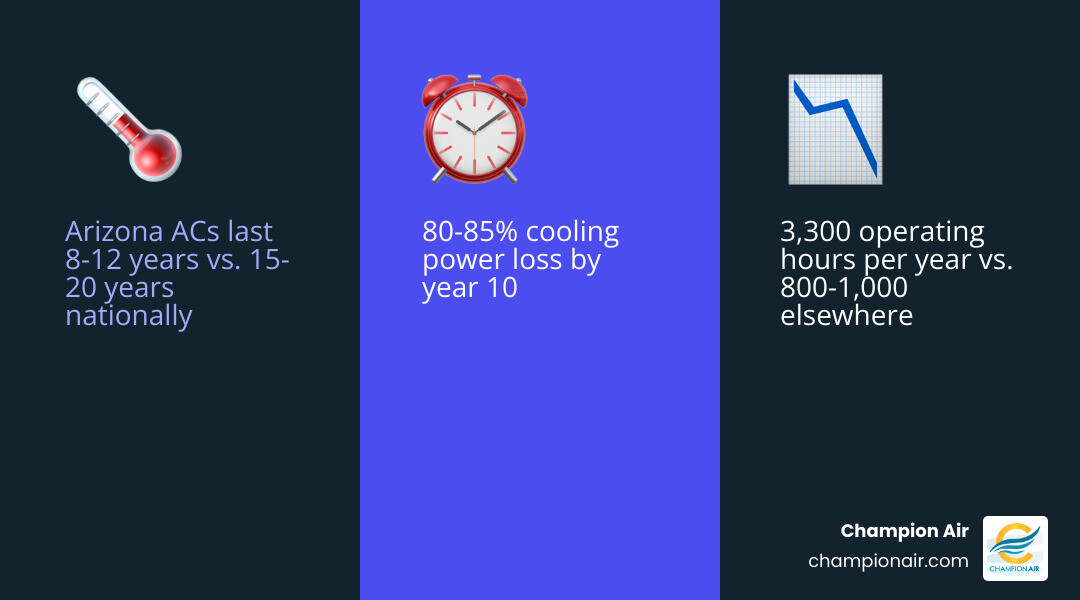
The result? Arizona AC units accumulate roughly 3,300 operating hours per year — compared to just 800 to 1,000 hours in more moderate parts of the country. That's the equivalent of aging your system in fast-forward.
I'm Barry Farah, an Arizona HVAC entrepreneur who leads the largest Lennox family-owned residential replacement company in the state — and understanding what shortens AC lifespan in Arizona has been central to my work helping thousands of homeowners protect their systems in this brutal climate. In the sections ahead, I'll walk you through each wear factor in detail so you know exactly what to watch for and what to do about it.
The "Arizona Tax": Comparing Desert Lifespan to National Averages
When we talk to homeowners in Scottsdale or Peoria, they are often shocked to learn that their air conditioner is considered a "senior citizen" by age 10. Nationally, the Department of Energy suggests a system should last nearly two decades. However, in the Sonoran Desert, we pay what I call the "Arizona Tax."
The sheer volume of work required to keep a home at 75°F when it is 115°F outside creates a massive disparity in equipment longevity. By its 10th year of service, the average central AC system in the Phoenix Valley typically delivers only 80% to 85% of its original cooling power. This efficiency drop-off happens because the internal components have essentially "run a marathon" every single summer.
| Metric | National Average | Arizona Average |
|---|---|---|
| Expected Lifespan | 15–20 Years | 8–12 Years |
| Annual Runtime Hours | 800–1,000 Hours | 3,000–3,300 Hours |
| Lifespan Reduction | 0% (Baseline) | 20% to 40% Reduction |
| Major Repair Threshold | Year 12–15 | Year 7–9 |
As you can see, the How Long Do Air Conditioners Last In Arizona question isn't just about the calendar; it's about the "mileage" on the compressor. In our region, a 10-year-old unit has worked as many hours as a 30-year-old unit in a cooler state like Washington or Maine.
Environmental Killers: What Shortens AC Lifespan in Arizona
Our environment is beautiful, but it is objectively hostile to mechanical equipment. Beyond the heat, we deal with specific desert elements that act like sandpaper on your system’s moving parts.

How Dust and Haboobs: What Shortens AC Lifespan in Arizona
In the Valley, we don't just get wind; we get haboobs. These massive walls of dust push fine particulate matter deep into the fins of your outdoor condenser coils. When these coils are caked in dirt, the system can't release heat efficiently. This forces the compressor to run hotter and longer to achieve the same cooling effect, leading to premature mechanical failure.
Furthermore, this dust acts as an abrasive. It gets into fan motors and bearings, causing friction that wears down metal components. Learning How To Protect Hvac In Dust Storm conditions is vital for any homeowner in Mesa or Chandler.
Intense UV Exposure and Component Decay
We enjoy over 300 days of sunshine a year, but those UV rays are relentless. High UV exposure causes plastic components to become brittle and eventually crack. We often see sun-bleached insulation on refrigerant lines that has simply crumbled away, leaving the copper pipes exposed. This lack of insulation causes the system to lose cooling capacity before the air even enters your home. Shading your outdoor unit—while maintaining proper airflow—can help mitigate some of this solar damage.
Additionally, How Hard Water Impacts Air Conditioners is a major concern if you use misting systems near your AC or if your unit is an evaporative hybrid. Mineral scaling can coat coils and restrict heat transfer just as effectively as dust.
Mechanical Stressors: How 160°F Attics Accelerate Wear
While the outdoor unit takes a beating, the indoor portion of your system is often fighting its own battle in the attic. In Phoenix, attic temperatures can easily reach 140°F to 160°F.
The Lack of Nighttime Recovery
In many parts of the country, the AC gets a break when the sun goes down. In Arizona, nighttime temperatures often stay above 90°F. This means the system never gets a "recovery period" where internal components can cool down to ambient levels. This constant thermal stress leads to the expansion and contraction of metal parts and puts immense strain on electrical components like capacitors and contactors, which are the most common points of failure during our July and August heatwaves.
If you've ever wondered How Long Should My Ac Run In Arizona, the answer is often "nearly constantly" during the peak of summer. Running for 10 to 16 hours a day is standard here, but it’s also a primary reason for the shortened lifespan.
Attic Micro-Climates and Duct Integrity
When your ductwork is sitting in a 160°F attic, even a tiny leak becomes a major problem. If your ducts aren't perfectly sealed, they suck in that superheated attic air, forcing your AC to work twice as hard to cool it back down. This "internal heat gain" is a silent killer of efficiency and equipment life.
Installation and Sizing: The Foundation of System Longevity
The day your AC is installed is the most important day of its life. If the foundation is shaky, the system will never reach its full potential, regardless of how much you spend on the brand.
Sizing Mistakes: What Shortens AC Lifespan in Arizona
Many people assume "bigger is better" when it comes to AC, but in the HVAC world, that’s a myth.
- Oversized Units: If a unit is too large for the square footage, it will "short-cycle." This means it turns on, cools the house very quickly, and shuts off before it can remove humidity. The constant starting and stopping is incredibly hard on the compressor—think of it like stop-and-go traffic versus highway miles for a car.
- Undersized Units: A unit that is too small will simply never stop running. It will struggle to reach the set temperature, leading to a compressor that is always under maximum load.
Why Professional Installation Matters
A quality installation involves more than just "hooking it up." It requires a precise refrigerant charge, secure electrical connections, and a perfectly balanced airflow. An improperly installed air conditioner can suffer a performance loss of up to 30% from day one. This puts immediate, unnecessary stress on the system and can shave 5 years off its expected life. At Champion Air, we emphasize that 9 Tips For Extending The Lifespan Of Your Air Conditioner always starts with a professional Manual J load calculation to ensure the perfect fit for your specific home.
Proactive Protection: Maintenance Strategies for 2026
You wouldn't drive a car 50,000 miles without an oil change, yet many people expect their AC to run 3,300 hours a year with no maintenance. In Arizona, preventative care isn't a luxury; it's a survival tactic for your equipment.
Managing the 8-Month Cooling Season
Our cooling season in cities like Surprise and Tempe can last from March through October. Because of the dust and constant runtime, we recommend bi-annual tune-ups.
- Spring Tune-Up: To prepare for the "Big Heat."
- Fall Tune-Up: To clean out the monsoon dust and check electrical components after a hard summer.
Regular maintenance can preempt up to 80% of all air conditioning repairs. Understanding Why Hvac Maintenance Agreements Are Important is about shifting from "reactive" repairs (which always happen on a Sunday in July) to "proactive" protection. We recommend checking How Often Schedule Maintenance based on your specific usage, but twice a year is the gold standard for Arizona. There are many Reasons Schedule Spring Ac Tune Up services, but the biggest one is simply ensuring the system survives the upcoming 115°F peaks.
Homeowner Habits for Longevity
You can reduce the load on your AC through simple lifestyle changes:
- The 78°F Rule: Every degree lower than 78°F significantly increases the workload on your compressor.
- Filter Changes: During the peak 8-month season, change your filters every 30 days. Think of a clogged filter like your AC trying to "breathe through a straw."
- Shading and Insulation: Use solar screens or blackout curtains on west-facing windows to keep the heat out before your AC has to deal with it.
Knowing When to Replace: The 5,000 Rule and Warning Signs
Even with perfect care, every system eventually reaches the end of the road. Knowing when to stop pouring money into an old unit is a vital financial decision.
The 5,000 Rule for Decision Making
If you're facing a major repair, use the "5,000 Rule." Multiply the age of your unit by the cost of the repair. If the result is more than 5,000, it’s usually time to replace. Example: A 10-year-old unit needing a $600 repair (10 x 600 = 6,000). In this case, replacement is likely the smarter investment.
Beyond the math, there are several Indicators It Is Time To Replace Hvac System components. If your system still uses R-22 (Freon), it is effectively obsolete. R-22 has been phased out, making any leak repair incredibly expensive. If you notice Signs Your Air Conditioner Is Low In Freon, such as ice on the lines or lukewarm air, and you have an older unit, a replacement is almost always more cost-effective than a recharge.
Critical Warning Signs of Failure
- Grinding or Banging: These are often the sounds of a compressor or fan motor on its last legs.
- Spiking Bills: If your utility bills are 20% higher than last year with the same usage, your system is losing the efficiency battle.
- Frequent Electrical Trips: If your AC is constantly tripping the circuit breaker, it’s likely "pulling" too many amps because the motor is failing.
Frequently Asked Questions about Arizona AC Lifespan
How long do AC units last in Phoenix compared to the rest of the US?
In Phoenix, you can expect 8 to 12 years on average. In more temperate states, 15 to 20 years is the norm. The 20% to 40% reduction in lifespan is due to the extreme operating hours and thermal stress of the desert.
Why does my AC run all night during the summer?
When outdoor temperatures stay above 90°F at night, your home loses heat very slowly. Your AC must continue running to remove the heat that soaked into your walls and roof during the day. If it runs 16 hours a day, that is normal for an Arizona July.
How often should I change my filters during a haboob season?
During the monsoon season (June–September), you should check your filter every 2 weeks and change it at least every 30 days. The fine dust from a single haboob can clog a standard filter almost instantly.
Conclusion
Understanding what shortens AC lifespan in Arizona is the first step toward protecting your home’s most important appliance. Between the 160°F attics, the abrasive haboob dust, and the relentless 3,300-hour annual runtimes, your air conditioner is under more pressure here than anywhere else in America.
At Champion Air, we’ve spent years perfecting the art of desert HVAC care. Whether you are in Scottsdale, Phoenix, or Mesa, our team is ready to help you extend the life of your current system or help you choose a high-efficiency replacement that can stand up to the "Arizona Tax." Don't wait for a 115°F day to find out your system is struggling.
Schedule your professional AC service with Champion Air today and let us help you keep your cool all year long.
Talk to a Champion
Have an HVAC question — or a quote you're not sure about?
Our free second opinion reviews any competitor quote line by line, and our team answers Valley HVAC questions every day. No pressure, no obligation — that's the Champion Air promise.
Talk to a Champion
Free Second Opinion
Already have a quote? We review it line by line, free. If it's fair, we'll tell you to take it.
About the Author
Champion Air
More Articles
View All PostsKeep Reading
Related Articles


Ready to Get Started?
Whether you need a repair, maintenance, or a new installation, our expert team is here to help.