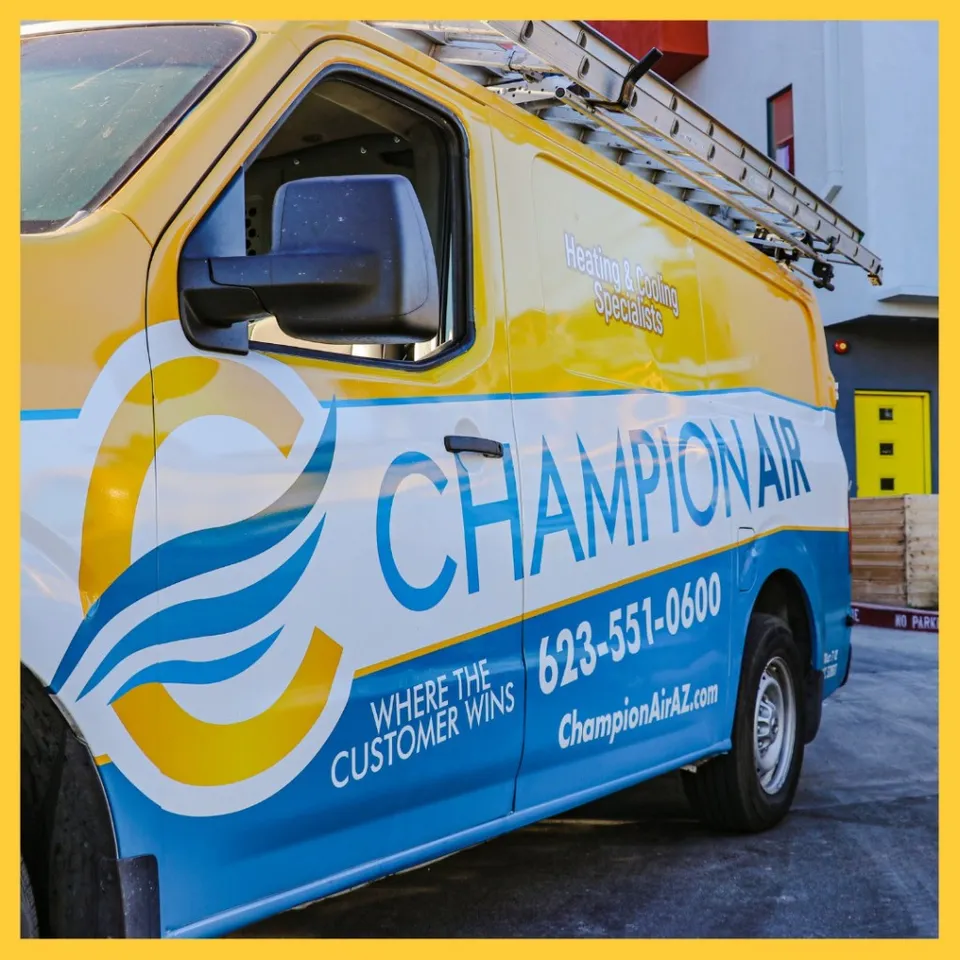
AC Installation & Replacement in Sun City, AZ
Professional HVAC service from Champion Air.
4.9★
Google Rating
1,000+
Reviews
Since 1982
Family owned
Dave Lennox
Award winner
24/7
Emergency service
Get Your AC Fixed Today
Same-day response · Transparent pricing · No pressure
- BBB A+ Rated
- Dave Lennox Award
- Licensed & Insured
- No Overtime Charges
- Pearl Certified
Is Your Aging Sun City AC Finally Ready for a Full Replacement?
Are your summer utility bills climbing higher every year, the back bedroom never quite cooling down, or have you been dreading the day your decades-old system finally quits while you are away? When repair after repair stops making sense, a properly sized full replacement is usually the cleaner path forward — and it deserves an honest assessment instead of a hard sell. The team at Champion Air is ready to walk you through your replacement options for your Sun City home.
Key Signs Your Air Conditioner Needs to Be Replaced
Your System Is Pushing 25 Years or More
The functional service life of cooling equipment in this part of Maricopa County tops out around twelve to fifteen years, yet many original Del Webb homes are still running on first or second-replacement systems installed back in the eighties or nineties. After two and a half to four decades of triple-digit summers, the compressor windings, contactors, and capacitors are simply fatigued past the point where a tune-up makes a meaningful difference. Replacing on your own timeline lets you compare equipment options and apply for APS or SRP rebates before they roll over. Waiting for the unit to die in August forces a rushed decision the moment you can afford it least.
Your APS or SRP Bills Keep Climbing Every Summer
You open the August utility bill and it has climbed another fifty or eighty dollars over last year even though your thermostat habits never changed. As your equipment ages, it loses the ability to cool your home efficiently, so it has to run far longer to deliver the same comfort — and every extra minute shows up on the meter. For homeowners on a fixed retirement income, the drag of an inefficient system across a cooling season is real money. A high-efficiency unit selected for APS or SRP rebate eligibility often pays back the efficiency premium inside the rebate window.
Back Bedrooms and Arizona Rooms That Will Not Cool
Most original Sun City homes were built with one thermostat controlling the whole house, which leaves the back bedroom or converted Arizona room at the far end of a duct run that was never sized to keep up. When your system was new, the imbalance might have been a few degrees, but an aging compressor and tired coil have widened the gap to ten or twelve degrees on hot afternoons. A properly sized new cooling system closes part of that gap by restoring full nameplate capacity, but the underlying single-zone layout still puts those distant rooms at a disadvantage. Honest equipment options usually involve a correctly matched main system plus a zoning or supplemental solution for the back rooms.
Your AC Was Installed Before 2010
Air conditioners installed before 2010 almost universally use R-22, a refrigerant federally phased out and no longer manufactured. As original line sets and coils develop micro-leaks under desert heat, the cost of a recharge from reclaimed supply has climbed dramatically. Once a pre-2010 system needs more than a top-off, the math tips toward an air conditioning replacement with R-410A equipment that runs at higher efficiencies on a refrigerant still readily available.
You Returned in the Fall to a Dead System
Snowbird absentee failures are the most common reason original-equipment owners call us in October instead of mid-summer. Thermostats set to 85 or 90 degrees across the May-through-September stretch hide a slowly failing compressor, a clogging condensate line, or a refrigerant leak until it is too late. When you walk back into a system that simply will not cool, full replacement is frequently the only path forward — particularly if the compressor seized while running short on refrigerant or a condensate overflow caused water damage.
Why Air Conditioning Systems Fail in Our Desert Climate
You're Running on Original 1960s Equipment
The single-stage condensers and base-model air handlers that came with most original Del Webb homes were specified to meet 1960s or 70s minimum standards at the lowest possible build cost. They were never engineered to survive five decades of slab-radiated heat, attic-baked refrigerant lines, and continuous summer run times. Even a system that seems to be limping along is running on worn-out electrical parts and a tired compressor. Patching one failed component on equipment this old usually just exposes the next weak link a few weeks later.
Your AC Was Patched Onto an Old Swamp Cooler Setup
A meaningful share of these homes started life with evaporative coolers and were converted to refrigerated air piecemeal across multiple decades. We frequently see the shortcuts those conversions left behind: outdoor units too small for the home, return-air paths sized for the old swamp cooler instead of the new AC, and abandoned roof shrouds still leaking hot attic air into your cooled supply ducts. A clean air conditioning replacement is often the moment those mismatches finally get corrected — sizing a new system properly to the envelope, abandoning the old swamp-cooler return cavity, and sealing every roof penetration so the next install actually lasts.
You're Paying to Cool Your Attic, Not Your Living Room
Sun City attics routinely hit 140 degrees or higher, and the original flexible ducting baking up there has spent six decades drying, cracking, and slipping at every collar. Even a brand-new high-efficiency unit will struggle to keep your home comfortable when every cooled BTU leaks into the rafters before reaching a register. We talk every homeowner through whether the existing duct system can support a new high-efficiency installation or whether it needs to be sealed or replaced. Skipping that conversation sets up the new equipment to underperform.
Each Refrigerant Repair Costs More Than the Last
Federal phaseout rules took R-22 production offline years ago, and the only remaining supply comes from reclaimed sources at sharply rising prices. Modern R-410A equipment uses a readily available refrigerant and runs at higher pressures with better heat transfer than the legacy chemistry it replaced.
Your Professional Air Conditioning Installation Process
When you call Champion Air for an air conditioning replacement, the conversation starts with a precise Manual J load calculation rather than a quick BTU rule of thumb. We measure your actual square footage, insulation, window orientation, and air leakage before specifying equipment, because oversizing an original Del Webb home is just as costly a mistake as undersizing one and produces short-cycling, humidity problems, and a shortened compressor life.
From there, we walk you through real equipment options without pressure. We explain SEER2 efficiency differences, single-stage versus two-stage compressors, and which configurations qualify for APS or SRP rebate programs, so the payback window is clear before you commit.
Meticulous Installation and System Testing
Our NATE-certified installation team handles the clean removal of your old condenser, air handler, and any abandoned swamp-cooler hardware still on the roof. We make new electrical, refrigerant, and condensate connections to current code, pull the appropriate permits, and adhere strictly to manufacturer specifications so the new high-efficiency unit performs as designed. We do not consider the job complete until we test the new system end to end — measuring the refrigerant charge, checking the airflow at every register, and confirming the temperature drop across the coil before we walk you through the new thermostat.
Protecting and Maximizing Your New Cooling Investment
Even the most efficient new cooling system struggles to perform when it is paired with attic ductwork that is leaking a third of its airflow into the rafters. We walk through the condition of your existing ducts before installation day and recommend the right combination of sealing, partial replacement, or full duct replacement based on what the airflow tests actually show, so your new investment delivers everything it is rated for from day one.
Permits, Inspections, and HOA Equipment Screening
A full system replacement requires a mechanical permit and a final inspection through the appropriate Maricopa County authority, and we handle that paperwork as part of the install. Pulling permits correctly the first time avoids headaches if you ever sell or refinance. Many Recreation Centers communities here also enforce HOA equipment-screening rules around rooftop visibility and color-matched condenser cabinets. We review the guidelines for your neighborhood before specifying equipment so the install clears HOA review without surprises.
The Long-Term Cost of an Outdated Cooling System
Every additional summer you stretch out of original equipment carries real costs well before a final breakdown. The monthly bill drag from a degraded compressor and a leaking duct system runs a few hundred dollars across a cooling season, and a single R-22 leak repair on a pre-2010 unit can quickly exceed what makes sense to spend preserving aging equipment.
For snowbird households the stakes run deeper. A compressor that fails silently in July leaves you returning in October to a system that has run dry, an air handler closet with water staining, and a forced full replacement at the worst possible moment.
Schedule Your Sun City AC Installation Today
Whether you are staring at a 35-year-old condenser that finally quit, original ductwork giving up in the attic, or a pre-2010 unit that costs too much to keep alive, the right new cooling system installed correctly the first time is the only way to break the cycle. Reach out to Champion Air today to schedule your replacement consultation, and let our local technicians plan a system that fits your Sun City home, your utility-rebate window, and the way you actually live in it.
Ready to book your visit?
Related Services In This Area
View areaAreas We Serve
All Service AreasWhy Choose Us
- Licensed, Bonded & Insured
- Upfront, Honest Pricing
- 100% Satisfaction Guarantee
- Same-Day Service Available
- Certified Lennox Premier Dealer
More Services
Related Services
Need a different service?
Ready to Get Started?
Contact us today for a free estimate on your AC Installation & Replacement in Sun City, AZ needs.