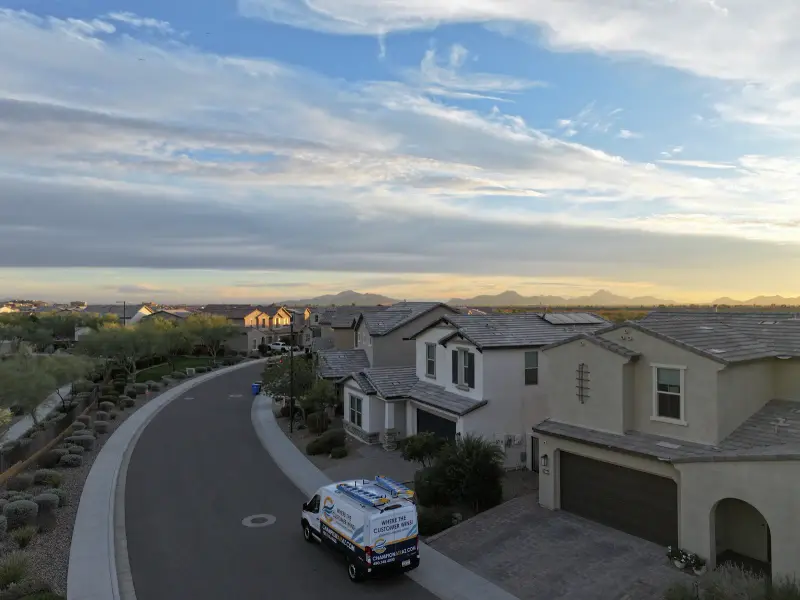
The Desert Ridge Home Intelligence Profile
How Desert Ridge homes are built, cooled, heated, and kept efficient — a complete homeowner's guide to one of North Phoenix's premier master-planned communities.
The Desert Ridge Home Intelligence Profile is Champion Air's community-specific guide to how Desert Ridge homes are built, cooled, heated, and kept efficient — from the community's late-1990s-through-2010s construction phases and original HVAC systems through duct design, the attic and building envelope, indoor air quality, upgrades, and long-term ownership strategy. It's written for Desert Ridge homeowners and buyers who want to make maintenance, repair, and replacement decisions with the whole home in view.
Desert Ridge is one of North Phoenix's premier master-planned communities, recognized for its blend of residential neighborhoods, retail destinations, golf, resorts, and convenient access to major employment centers. Developed primarily from the late 1990s through the 2010s, it features a diverse mix of production homes, semi-custom properties, luxury residences, and townhomes.
As those homes mature, owners increasingly face decisions involving equipment replacement, indoor air quality, energy efficiency, and long-term maintenance. This profile examines the home as a complete comfort system — construction, original equipment, ductwork, the attic and building envelope, air quality, upgrades, and long-term planning.
Published July 2026 by the Champion Air team.
Part 1
Community Overview
Desert Ridge is one of North Phoenix's premier master-planned communities — residential neighborhoods, retail destinations, golf, and resorts developed primarily from the late 1990s through the 2010s, with a housing mix that runs from entry-level production homes to executive residences exceeding 4,000 square feet.
Where Desert Ridge sits — and why it matters
Located near Loop 101 and Tatum Boulevard, Desert Ridge offers excellent access to Scottsdale, the Mayo Clinic area, Deer Valley, and Sky Harbor Airport. Its proximity to Desert Ridge Marketplace and High Street has made it one of the Valley's most desirable places to live.
The homes and the climate they live in
Builders here emphasized open floor plans, high ceilings, large windows, and indoor-outdoor living spaces — features that directly influence HVAC design and cooling performance in Arizona's climate. Like the rest of the northern Phoenix area, Desert Ridge experiences long cooling seasons, intense solar gain, very low humidity for much of the year, and summer temperatures frequently above 110°F. Those conditions place significant demands on residential HVAC systems.
Champion Air has serviced homes throughout the Desert Ridge area for years and has developed community-specific knowledge of common construction practices, HVAC designs, airflow characteristics, and long-term equipment performance. This guide shares those insights so homeowners can maximize comfort, efficiency, reliability, and indoor air quality.
Part 2
Construction Profile
Most of Desert Ridge was developed from the late 1990s through the 2010s. Because construction occurred over multiple phases, homes range from original production models to extensively remodeled and custom residences.
Who built Desert Ridge
The community's neighborhoods came from a roster of major builders:
- Pulte Homes
- Shea Homes
- Fulton Homes
- DR Horton
- Lennar
- Richmond American
- Toll Brothers (select luxury neighborhoods)
- Various custom home builders
Construction characteristics
Across builders, the construction profile is consistent:
- Wood-frame construction with stucco exteriors
- Concrete tile roofing
- Vented attics with blown insulation
- Open-concept floor plans
- Large west-facing windows in many homes
- High ceilings and expansive great rooms
- Attached two-, three-, and four-car garages
What that means for HVAC
These architectural features create significant cooling loads during Arizona summers. High ceilings, large glass areas, and open living spaces require proper Manual J load calculations, balanced airflow, and correctly sized equipment to achieve consistent comfort.
Many Desert Ridge homes have now reached the point where original HVAC equipment has been replaced or is nearing replacement, and renovations frequently include flooring, windows, kitchens, and room additions. Champion Air has observed that these homes perform best when replacement systems are designed around the home's current condition rather than its original construction plans — evaluating airflow, ductwork, insulation, and static pressure alongside equipment selection consistently produces superior comfort and efficiency.
Part 3
Original HVAC Systems
Most original Desert Ridge homes were equipped with split-system air conditioners or heat pumps installed between the late 1990s and early 2010s. Those systems were appropriately designed for the standards of their era — but many are now beyond, or approaching, their expected service life.
What the builders installed
Common manufacturers across the community include Lennox, Carrier, Trane, York, Goodman/Amana, and Rheem/Ruud. The typical original system profile:
- Single-stage compressors
- PSC or early ECM indoor blower motors
- R-22 refrigerant in older installations, R-410A in newer construction
- 80% gas furnaces or electric air handlers depending on neighborhood
- Basic programmable thermostats
What has changed — and what to check before replacing
Today's variable-capacity systems provide dramatically better temperature control, quieter operation, higher efficiency, improved humidity management during monsoon season, and advanced communicating controls compared with many original systems.
Before replacement, the checklist matters: perform a Manual J load calculation, evaluate ductwork and static pressure, verify return-air capacity, commission the system after installation, and consider indoor air quality upgrades while the system is open. Many comfort issues attributed to aging equipment are actually caused by airflow restrictions or duct performance — Champion Air evaluates the complete comfort system before recommending replacement so the new equipment performs to its full potential.
Part 4
Original Duct Design
Most Desert Ridge homes were constructed with duct systems that met the residential design standards of their era: a sheet-metal supply plenum connected to insulated flexible branch ducts routed through vented attics. Effective when new — but these systems often require evaluation as homes age and comfort expectations evolve.
Typical characteristics
The original air-distribution recipe across the community:
- Sheet-metal supply trunks with flexible branch ducts
- Ceiling-mounted supply registers
- Central return-air grille with limited return pathways in some floorplans
- Ductwork located in high-temperature vented attics
- Insulated flexible duct common throughout production homes
Common performance challenges
What develops over 15-25 years of Arizona service:
- High attic temperatures reducing cooling efficiency
- Restricted airflow from aging or compressed flex duct
- Elevated static pressure
- Uneven room temperatures
- Limited return-air capacity in remodeled homes
- Air leakage at duct connections over time
Why ductwork matters
The duct system is the delivery network for conditioned air — even the highest-efficiency HVAC equipment cannot achieve its rated performance if airflow is restricted or poorly balanced. Today's diagnostic tools measure airflow, static pressure, and duct leakage with far greater accuracy than was common during original construction, and air balancing, duct sealing, return-air improvements, and strategic duct modifications often produce significant comfort gains without changing the home's layout.
Champion Air evaluates the complete air distribution system, not just the equipment: testing static pressure, measuring airflow, inspecting duct condition, and verifying return-air performance to find the opportunities that improve comfort, efficiency, and system longevity.
Part 5
Attic & Building Envelope
The air conditioner is only one component of a home's comfort system. The building envelope — attic, insulation, windows, doors, walls, roof, and air sealing — determines how much heat enters the home before the HVAC system even begins cooling it. In Desert Ridge, where summer temperatures regularly exceed 110°F, envelope quality has a direct impact on comfort, energy consumption, and HVAC longevity.
The attic reality
Most Desert Ridge homes were built with vented attics, concrete tile roofs, engineered trusses, blown fiberglass insulation, stucco exteriors, dual-pane windows, and attic-mounted HVAC equipment. These assemblies met the building codes of their time, but many homes are now 15-25 years old and benefit from reevaluation.
Summer attic temperatures commonly reach 130°F to 150°F. Because ductwork and HVAC equipment often operate in that environment, poor insulation or air leakage can substantially increase cooling costs and reduce equipment efficiency. Original attic insulation generally ranged from R-30 to R-38 depending on construction year — and over time it settles, becomes displaced, or loses effectiveness around attic access openings and service pathways. Many homeowners benefit from restoring or increasing insulation after an inspection.
Air sealing, windows, and solar gain
Small openings around plumbing penetrations, electrical wiring, recessed lights, exhaust fans, attic hatches, and refrigerant line penetrations allow superheated attic air into conditioned living spaces — sealing those pathways often improves comfort while reducing HVAC runtime.
Large west-facing windows are common throughout Desert Ridge. They provide abundant natural light, but they also contribute significant afternoon solar heat gain; modern low-E glass, quality window films, exterior shading, and strategic landscaping can all reduce cooling loads. Supply ducts routed through extremely hot attics are equally vulnerable — proper duct insulation, sealing, and static pressure management preserve conditioned air before it reaches occupied rooms.
Comfort depends on how every component works together. Increasing attic insulation while ignoring duct leakage, or replacing equipment without evaluating airflow, often limits the benefits of either improvement. Champion Air approaches Desert Ridge homes as complete building systems — evaluating attic conditions, insulation, duct performance, airflow, return-air capacity, and envelope characteristics together.
Part 6
Comfort Characteristics
Desert Ridge homes are generally comfortable thanks to modern floorplans and quality construction, but their design creates airflow and temperature patterns that become more noticeable during Arizona's long cooling season.
Common comfort patterns
The patterns homeowners report most often:
- Warmer west-facing rooms during late afternoon
- Second-story temperature differences
- Great rooms requiring higher airflow volumes
- Primary suites that cool differently from secondary bedrooms
- Temperature swings in rooms with large windows
Seasonal influences and root causes
During extreme summer heat, HVAC systems often operate continuously through the afternoon — and during monsoon season, elevated humidity can make indoor temperatures feel warmer even when thermostat settings haven't changed. The underlying factors are airflow balance, return-air design, attic insulation, duct condition, solar heat gain, window orientation, and occupancy patterns.
Champion Air has found that most comfort complaints are not caused by one defective component but by several small factors working together. Measuring airflow, static pressure, room temperatures, and building performance identifies the root causes — so the fix is a lasting solution rather than a temporary patch. Variable-capacity systems, zoning where appropriate, smart thermostats, improved filtration, duct optimization, and whole-home air balancing can all significantly improve consistency.
Part 7
Indoor Air Quality
Arizona is often associated with dry, clean air, but Desert Ridge homeowners face a unique mix of airborne contaminants — desert dust, pollen, fine particulates, construction dust, pet dander, and seasonal monsoon humidity. Indoor air quality has become one of the fastest-growing concerns for homeowners seeking healthier, more comfortable homes.
Common indoor air pollutants
What actually circulates through a Desert Ridge home:
- Desert dust and fine particulate matter
- Pollen from desert vegetation
- Pet dander, hair, and household dust mites
- Cooking particles and odors
- Volatile organic compounds (VOCs)
- Mold growth from localized moisture issues or drain problems
The HVAC system's role — and the monsoon factor
The HVAC system continuously circulates indoor air, making filtration, airflow, and ventilation critical to air quality. Dirty filters, inadequate airflow, or neglected maintenance reduce filtration performance and distribute contaminants throughout the home. And although Phoenix is typically dry, monsoon season introduces higher humidity — moisture around condensate drains, evaporator coils, or poorly insulated ducts can contribute to microbial growth if not managed.
Modern solutions include high-efficiency media filtration, whole-home air purification, UV or photocatalytic technologies where appropriate, humidity management, routine evaporator coil cleaning, and duct inspections with cleaning when warranted. Champion Air evaluates filtration, airflow, equipment cleanliness, duct condition, and ventilation before recommending anything — every home is different, so IAQ improvements should be based on measured needs rather than one-size-fits-all products.
Questions about your Desert Ridge home so far?
Call (480) 748-4000 or schedule a visit — we'll walk the same whole-home checklist this guide does, in your actual house.
Part 8
Common HVAC Repairs
As Desert Ridge homes mature, many HVAC systems are reaching 15-25 years of service — and Arizona's extended cooling season accelerates wear on mechanical and electrical components.
The most common repairs
The calls Champion Air runs most often in this community:
- Capacitor and contactor replacement
- Condensate drain clogs
- Blower motor repairs and ECM module failures
- Compressor hard-start issues
- Refrigerant leak diagnosis and evaporator coil leaks
- Condenser fan motor replacement
- Control board and thermostat issues
Monsoon season and prevention
Heavy dust, wind, lightning, and humidity during monsoon season frequently contribute to clogged drains, surge damage, dirty outdoor coils, and increased system stress. Annual maintenance, coil cleaning, drain flushing, electrical testing, airflow verification, and replacing worn components before failure all reduce unexpected breakdowns.
When a repair does come up, the repair-versus-replacement decision should consider system age, refrigerant type, repair frequency, efficiency, warranty status, and the overall condition of the complete system rather than a single failed component. Champion Air emphasizes accurate diagnosis first — evaluating electrical performance, airflow, refrigerant operation, static pressure, and overall equipment health so homeowners understand both the immediate repair and the long-term outlook.
Part 9
Comfort Upgrades
Many Desert Ridge homeowners eventually discover that replacing an air conditioner alone does not resolve uneven temperatures, high utility bills, excessive dust, or inconsistent comfort. The most successful improvements come from treating the home as a complete comfort system — modern HVAC technology, airflow optimization, building-envelope improvements, and indoor air quality solutions working together.
Variable-capacity systems and smart controls
Variable-capacity HVAC systems continuously adjust their output to match the home's changing cooling demand instead of cycling fully on and off. In Arizona's climate, that usually means longer, quieter run times, more consistent temperatures, lower energy consumption, and improved humidity control during monsoon season.
Communicating smart thermostats add remote access from mobile devices, energy reporting, equipment diagnostics, scheduling and occupancy-based operation, and maintenance reminders.
Airflow, air quality, and envelope improvements
Many Desert Ridge homes benefit more from airflow improvements than homeowners expect — air balancing, return-air upgrades, static-pressure correction, duct sealing, and replacement of damaged flexible duct can significantly improve comfort without changing the home's layout.
The rest of the upgrade menu rounds out the whole-home strategy:
- High-capacity media filtration and whole-home air purification
- UV or advanced purification technologies where appropriate
- Activated carbon odor control and improved filter cabinet sealing
- Additional attic insulation and air sealing around attic penetrations
- Solar-control window film and weatherstripping
- HVAC surge protection, compressor protection, and condensate overflow safety switches
The greatest improvements usually come from combining multiple upgrades rather than relying on a single product. Champion Air develops customized upgrade plans based on engineering rather than assumptions — every recommendation begins with evaluating airflow, static pressure, equipment performance, duct condition, and the building envelope.
Part 10
Utility Performance & Energy Efficiency
Cooling is typically the largest residential energy expense in Desert Ridge. Long summers, afternoon sun, and extended HVAC runtime make efficiency especially important.
What drives utility bills
The variables that show up on the bill:
- HVAC system efficiency and equipment age
- Airflow restrictions and duct leakage
- Attic insulation and window solar gain
- Thermostat settings and occupancy patterns
Utility plans and real-world efficiency
Most Desert Ridge homeowners receive electricity from APS or SRP depending on location, and time-of-use plans, demand plans, and seasonal rates can all influence operating costs and thermostat strategies — worth confirming against the name on your bill.
High-efficiency variable-capacity equipment, proper Manual J sizing, duct sealing, static-pressure correction, attic insulation, air sealing, and smart thermostat optimization provide the greatest long-term savings. Equipment efficiency ratings matter, but real-world performance also depends on installation quality, commissioning, refrigerant charge, airflow, and duct design — which is why Champion Air focuses on total system efficiency rather than equipment ratings alone.
Part 11
Seasonal HVAC Challenges
Much of the country experiences four traditional seasons; HVAC systems in Desert Ridge operate through distinct environmental periods that each place different demands on home comfort systems.
Spring and extreme summer
Spring brings heavy pollen and airborne dust, pre-season equipment startups, and increasing daytime cooling demand — the ideal window for preventive maintenance. Extreme summer follows with daily temperatures exceeding 110°F, long equipment run times, peak electrical demand, and increased wear on compressors, capacitors, and fan motors.
Monsoon season and winter
Monsoon season layers higher humidity, dust storms that contaminate outdoor coils, lightning and power surges, and condensate drain issues on top of peak cooling. Winter shifts the focus: heating system testing, heat pump defrost cycles where applicable, furnace safety inspections, and filter replacement.
Routine maintenance before peak cooling season remains the most effective way to improve reliability, maintain efficiency, and avoid emergency repairs during extreme weather. Champion Air prepares Desert Ridge homeowners for each season rather than reacting after failures — inspecting electrical components, airflow, refrigerant performance, drainage systems, and overall equipment health before the extremes arrive.
Part 12
Luxury Home HVAC Considerations
Many Desert Ridge luxury homes feature expansive floor plans, tall ceilings, large areas of glass, outdoor living spaces, and multiple comfort zones. These characteristics require HVAC systems that are engineered — not simply oversized — to deliver exceptional comfort year-round.
Common luxury home challenges
Where bigger homes create harder problems:
- Large west-facing window exposure
- Multi-story temperature balancing
- High ceilings and large open spaces
- Home offices and media rooms with higher internal heat loads
- Guest suites that are infrequently occupied
- Outdoor air infiltration from large sliding glass doors
High-end comfort features and long-term ownership
The features that answer those challenges: variable-capacity HVAC systems, communicating thermostats, multiple independent comfort zones, dedicated filtration and air purification, whole-home humidity awareness, and quiet indoor operation. Luxury homes also contain hardwood flooring, custom cabinetry, artwork, electronics, and premium furnishings that benefit from stable temperatures, proper airflow, and clean indoor air.
Many Desert Ridge homeowners stay in their homes for years, so investing in properly designed systems, preventive maintenance, surge protection, and envelope improvements often reduces lifetime ownership costs while improving comfort. Champion Air starts every luxury project by understanding the home's architecture, occupancy patterns, comfort expectations, and ownership goals — the objective is a system that performs quietly, efficiently, and consistently while complementing the quality of the home itself.
Part 13
Champion Air's Recommended Comfort Strategy
Every Desert Ridge home is unique. Rather than recommending the same solution for every homeowner, Champion Air begins by understanding how the home performs and what the homeowner wants to improve — recommendations built on engineering principles, measured system performance, and long-term ownership value.
Step 1: Understand the home
Before any measurement, the conversation:
- Discuss comfort concerns and homeowner goals
- Review equipment age and service history
- Evaluate utility usage patterns
- Identify hot or cold rooms and airflow concerns
Step 2: Measure system performance
Then the diagnostics:
- Manual J load calculation for replacement systems
- Static pressure testing and airflow measurement
- Duct inspection
- Equipment performance testing
- Thermostat verification
Steps 3 and 4: Prioritize, then protect
After testing, we recommend improvements in order of greatest impact — equipment replacement, airflow optimization, duct improvements, filtration, indoor air quality enhancements, attic upgrades, or preventive maintenance, depending on what the measurements show.
Every comfort strategy then includes ongoing maintenance to preserve efficiency, catch developing issues early, and maximize equipment lifespan through Arizona's demanding climate. Comfort is not created by a single product — it is created by an entire system working together, and our goal is solutions that are technically sound, financially responsible, and built to deliver dependable comfort for many years.
Part 14
What Champion Air Has Learned from Servicing Desert Ridge Homes
Every community develops predictable HVAC patterns over time. After servicing homes throughout Desert Ridge, Champion Air has identified recurring construction characteristics, comfort concerns, maintenance trends, and upgrade opportunities that help homeowners make better long-term decisions.
Lessons we've learned
The findings that repeat across the community:
- Most comfort complaints are airflow-related rather than equipment-related
- Preventive maintenance dramatically reduces peak-summer breakdowns
- Manual J sizing is critical when replacing original equipment
- Indoor air quality has become a top homeowner priority
- Small improvements across multiple systems often outperform one major upgrade
What makes the biggest difference
Homeowner goals here are consistent — lower utility bills, more consistent room temperatures, quieter operation, cleaner indoor air, and long-term reliability. And consistently, the homes that perform best combine quality installation, proper airflow, preventive maintenance, high-efficiency equipment where appropriate, and a well-maintained building envelope.
Champion Air applies the lessons from every service call, repair, and installation to the recommendations we give future homeowners. Every home teaches us something — and that experience lets us recognize patterns quickly, diagnose accurately, and recommend practical solutions designed for Arizona's climate, not generic national averages.
Part 15
Conclusion & Long-Term Comfort Strategy
Desert Ridge has matured into one of North Phoenix's premier residential communities. As homes continue to age, thoughtful HVAC planning becomes increasingly important for protecting comfort, efficiency, and long-term property value.
Key takeaways
The profile in six lines:
- Understand your home's original HVAC design
- Invest in preventive maintenance before peak summer
- Address airflow and duct issues early
- Use Manual J sizing for future replacements
- Consider indoor air quality and energy efficiency together
- View HVAC as a complete comfort system rather than individual components
The long-term comfort roadmap
Champion Air recommends periodically evaluating system performance, building envelope improvements, filtration, thermostat technology, and equipment lifecycle — so upgrades can be made proactively instead of during emergency failures.
Our mission is to help Desert Ridge homeowners make informed decisions through education, engineering, and exceptional workmanship. By combining local experience with proven design standards, we strive to deliver reliable comfort that lasts for decades.
Put the profile to work in your home
Desert Ridge homes combine modern master-planned construction with one of the longest cooling seasons in the country. Understanding how HVAC systems, ductwork, insulation, airflow, indoor air quality, and the building envelope work together turns maintenance, repair, and upgrade decisions from guesswork into strategy — and it's exactly how Champion Air approaches every Desert Ridge home we service.
Keep exploring
The pages Desert Ridge homeowners pair with this profile — neighboring community guides, honest pricing, and the deep dives on the upgrades this profile recommends.