Don't Get Burned by a Bad AC Installation
Champion Air
Discover what separates a good AC installation from a bad one. Learn Manual J sizing, proper placement, calibration & more for Arizona homes.
What Separates a Good AC Installation From a Bad One (And Why It Matters in Arizona)
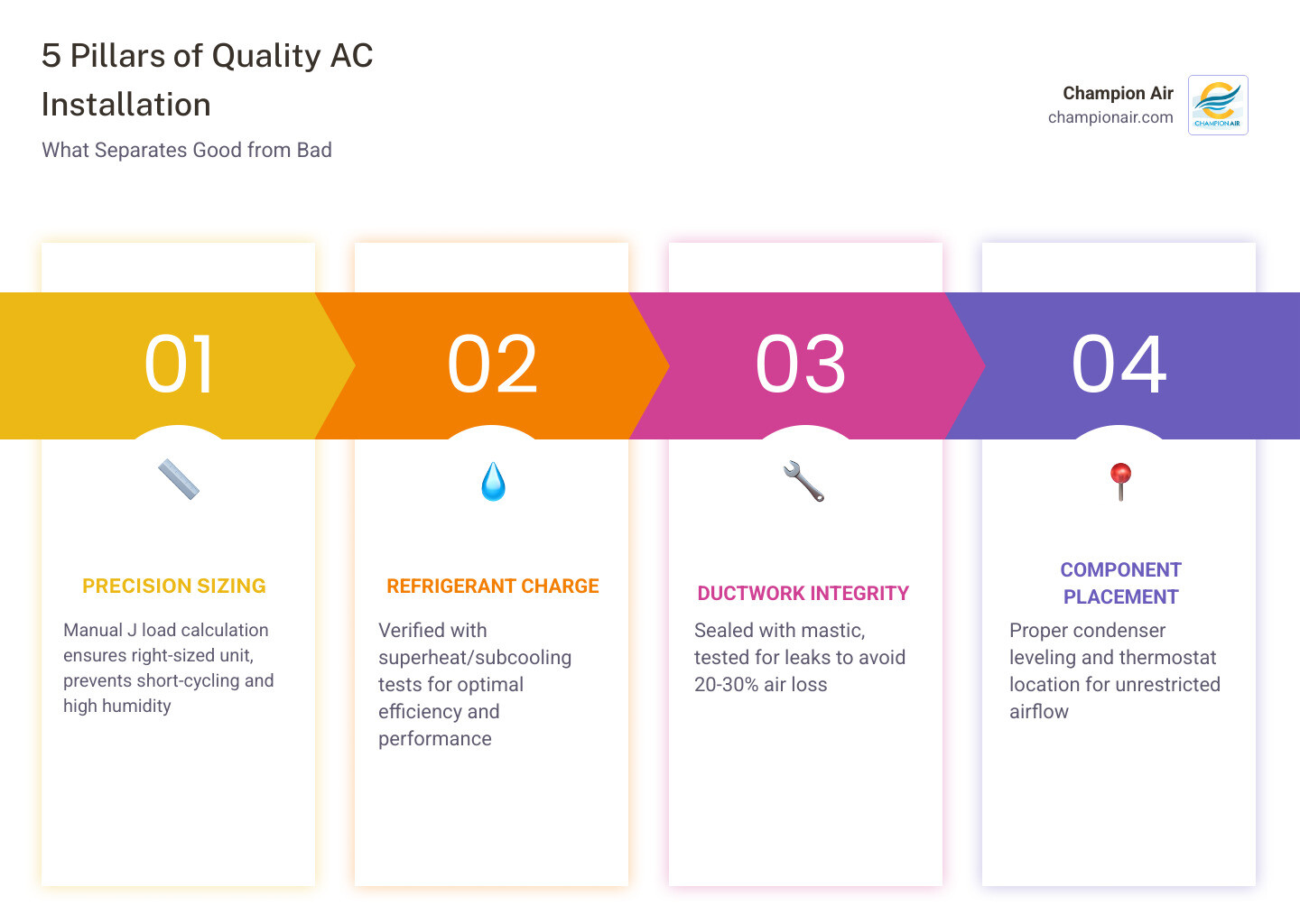
What separates a good ac installation from a bad one comes down to five core factors:
| Factor | Good Installation | Bad Installation |
|---|---|---|
| Sizing | Manual J load calculation performed | Old unit size copied without assessment |
| Refrigerant Charge | Verified with superheat and subcooling tests | Guessed or left at factory charge |
| Ductwork | Sealed with mastic, airflow balanced | Leaky connections, no pressure testing |
| Component Placement | Condenser leveled, thermostat away from heat sources | Placed for installer convenience, not performance |
| Commissioning | Delta T verified, documentation provided, warranty registered | System turned on and crew leaves |
Here's the uncomfortable truth: you can buy a top-of-the-line air conditioner and still end up with a system that underperforms, drives up your energy bills, and fails ahead of schedule — all because of how it was installed. According to Energy Star, a poorly executed HVAC installation can slash operating efficiency by as much as 30%. In an Arizona summer, where your AC may account for a significant portion of your total home energy use, that's not a small number.
The equipment is only half the story. A rushed crew that skips load calculations, ignores duct integrity, or leaves without verifying refrigerant charge isn't finishing the job — they're starting a slow-burn problem that will cost you for years.
I'm Barry Farah, and after leading one of Arizona's largest residential HVAC replacement companies and earning recognition including Lennox Partner of the Year, I've seen exactly what separates a good ac installation from a bad one — and the difference between the two is far more technical than most homeowners realize. In the sections below, I'll walk you through each factor so you know what to look for and what to demand from any installer who shows up at your door.
Precision Sizing and the Manual J Calculation

In HVAC, "bigger is better" is a dangerous myth. If a contractor walks into your home, glances at your old unit, and says, "Yep, looks like a 4-ton, let’s swap it for another 4-ton," you should be concerned. This is known as a "box swap," and it is the hallmark of a subpar installation.
To determine what size AC unit you need, a professional must perform a Manual J load calculation. This isn't just a guess based on square footage. It is a detailed engineering assessment that considers:
- The total square footage and ceiling height of your home.
- The orientation of your home (which rooms face the harsh Arizona afternoon sun).
- The R-value of your attic and wall insulation.
- The number, type, and age of your windows.
- The number of occupants and heat-producing appliances.
Many homeowners realize it's time for a change after seeing indicators that it is time to replace their HVAC system, such as rising bills or uneven cooling. But if the new unit isn't sized correctly for your current home conditions, those problems will simply persist in a brand-new, expensive machine.
Why sizing is what separates a good ac installation from a bad one
Sizing is the foundation of comfort. If the unit is oversized, it will suffer from "short-cycling." This means the unit turns on, blasts the house with cold air, and shuts off in under 10 minutes because it hit the temperature target too fast. This sounds efficient, but it’s a disaster. It never runs long enough to remove humidity, leaving you with a "cold but clammy" home. Furthermore, the frequent starting and stopping places immense strain on the compressor, leading to premature failure.
If the unit is undersized, it will run almost 24/7 during a Phoenix July, struggling to keep up. This leads to massive energy waste and a system that burns itself out years before its time. When you consider the air conditioner replacement cost, you want to ensure that investment is protected by a system that is perfectly matched to your home's heat load.
What Separates a Good AC Installation From a Bad One in Arizona?
In the desert, the environment is a "stress test" for HVAC equipment. A unit that works fine in a milder climate might fail here if the installation geography is wrong. A quality AC installation and replacement in Phoenix requires strategic thinking about where the equipment lives.
Outdoor Condenser Placement: The outdoor unit needs to breathe. A bad installation might tuck the unit into a tight corner or hide it behind dense bushes for "curb appeal." This suffocates the system. We recommend at least 2 to 3 feet of side clearance and 5 feet of unobstructed space above the unit. Without this, the unit recirculates its own hot exhaust air, forcing it to work significantly harder.
Leveling and Stability: The condenser must be mounted on a thick, level composite or concrete pad. If the unit is tilted, the oil inside the compressor won't distribute evenly, and the condensation won't drain properly. A tilted unit is a unit that is vibrating itself to death and inviting rust.
How component placement impacts what separates a good ac installation from a bad one
It isn't just about the outdoor unit; the "brain" of the system—the thermostat—and the delivery gateways (the vents) must be placed with precision as part of our air conditioning services.
- Thermostat Location: A common mistake in bad installations is placing the thermostat near a drafty window, in direct sunlight, or right next to a kitchen heat source. This "tricks" the sensors, causing the AC to run when it shouldn't or shut off while the rest of the house is still sweltering.
- Vent Obstruction and Balance: A good installer evaluates the airflow to every room. They ensure that supply vents aren't blocked by future furniture placement and that return air paths are sufficient. If you have a room that is always 5 degrees warmer than the rest, it’s often a sign of poor vent placement or unbalanced ductwork during the initial AC installation and replacement.
Technical Calibration: Refrigerant, Airflow, and Drainage
Once the equipment is set, the "commissioning" phase begins. This is where the technical experts separate themselves from the amateurs.
| System Type | Capacity Adjustment | Temperature Precision | Efficiency |
|---|---|---|---|
| Single-Stage | On (100%) or Off (0%) | +/- 2-3 Degrees | Basic |
| Two-Stage | 65% or 100% | +/- 1-2 Degrees | High |
| Variable-Speed | 25% to 100% | +/- 0.5 Degrees | Ultra-High |
Refrigerant Charge: Refrigerant is the lifeblood of your AC. Many installers assume the "factory charge" is enough. It rarely is. A good installation involves using gauges to measure "superheat" and "subcooling" to ensure the charge is exact. An incorrect charge—even by a few ounces—can reduce efficiency and cause the evaporator coil to freeze into a block of ice.
Airflow and Delta T: We look for a "Delta T"—the temperature difference between the air entering the return and the air leaving the supply vents—of 16°F to 22°F. If your system is outside this range, it’s a red flag that the airflow or refrigerant levels are off. Understanding everything to know about SEER ratings is great, but a 20 SEER unit will perform like a 14 SEER unit if the airflow isn't calibrated correctly.
Drainage Safety: In Arizona, we don't deal with as much humidity as the South, but our units still pull gallons of water from the air. A bad installation might have a poorly sloped drain line that clogs and leaks into your ceiling. A good installation includes a secondary drain line and a "safety float switch" that automatically shuts the system down if a backup is detected, preventing thousands of dollars in water damage.
Ductwork Integrity and Electrical Safety
You can have the most efficient AC in the world, but if your ducts are leaky, you're essentially paying to cool your attic. The average home loses 20–30% of conditioned air through leaks.
Sealing the Gaps: A quality installer doesn't use "duct tape" (which ironically is terrible for ducts because the adhesive dries out). They use mastic sealant or metal-backed tape to ensure a permanent, airtight seal. This is one of the most effective tips for extending the lifespan of your air conditioner because it reduces the total workload on the system.
Static Pressure: A professional will measure "static pressure" to see how hard the blower motor has to work to push air through your ducts. If your ducts are too small for your new high-efficiency unit, the motor will burn out prematurely.
Electrical Integrity: Bad installations often feature "spaghetti wiring"—loose, tangled connections that are a fire hazard. We ensure that the circuit breakers are sized correctly for the new equipment's draw and that all connections are secure and weather-protected.
Frequently Asked Questions about AC Installation Quality
What is a Manual J load calculation and why is it essential?
A Manual J calculation is the industry-standard method for determining exactly how much cooling power your specific home requires. It accounts for your home’s unique construction materials, window types, and orientation to the sun. It is essential because it prevents the two biggest killers of HVAC systems: oversizing and undersizing. Without it, your installer is just guessing with your money.
How can I tell if my new AC unit is the right size for my home?
The best indicator is your home's comfort and humidity. If the unit runs for 15–20 minutes and the house feels crisp and comfortable, it’s likely sized correctly. If it turns on and off every 5 minutes (short-cycling) and the air feels "heavy" or humid, it’s likely too large. If it runs all day and never reaches the temperature on the thermostat, it’s likely too small.
What are the warning signs of a poor AC installation after it's complete?
Watch out for these red flags:
- Unusual Noises: Rattling, whistling, or banging usually points to loose components or poorly sized ducts.
- Sky-High Bills: If your "high-efficiency" unit costs more to run than your old one, the calibration is likely wrong.
- Uneven Temperatures: Significant hot or cold spots between rooms suggest poor airflow balancing.
- Musty Smells: This often indicates standing water in an improperly sloped drain pan.
Conclusion
At Champion Air, we believe that an AC installation isn't just a "swap"—it's a precision setup of a complex mechanical system. Our licensed technicians don't just "hook it up and hope." We perform a full commissioning process, verify the Delta T, and provide you with a complete walkthrough of your new system, including how to maintain your filters and use your new thermostat.
We also handle the heavy lifting of manufacturer warranty registration for you, ensuring your investment is protected for the long haul. Whether you need an AC installation and replacement in Scottsdale, Phoenix, or Mesa, we bring the technical expertise required to handle the Arizona heat.
Don't settle for a "good enough" installation that leaves you burned. Choose a team that understands the science behind the cooling. Give us a call at Champion Air today, and let’s make sure your home stays a desert oasis for years to come.
Talk to a Champion
Have an HVAC question — or a quote you're not sure about?
Our free second opinion reviews any competitor quote line by line, and our team answers Valley HVAC questions every day. No pressure, no obligation — that's the Champion Air promise.
Talk to a Champion
Free Second Opinion
Already have a quote? We review it line by line, free. If it's fair, we'll tell you to take it.
About the Author
Champion Air
More Articles
View All PostsKeep Reading
Related Articles


Ready to Get Started?
Whether you need a repair, maintenance, or a new installation, our expert team is here to help.