The Heat is On and Your AC is Off
Champion Air
Learn what to do when your ac breaks down in extreme heat: DIY fixes, cool your home, find cooling centers & call Phoenix pros now!
My AC Stopped Working in the Phoenix Heat — What Should I Do First?
Knowing what to do when your ac breaks down in extreme heat could genuinely save your life — especially in Arizona. Here's what to do right now:
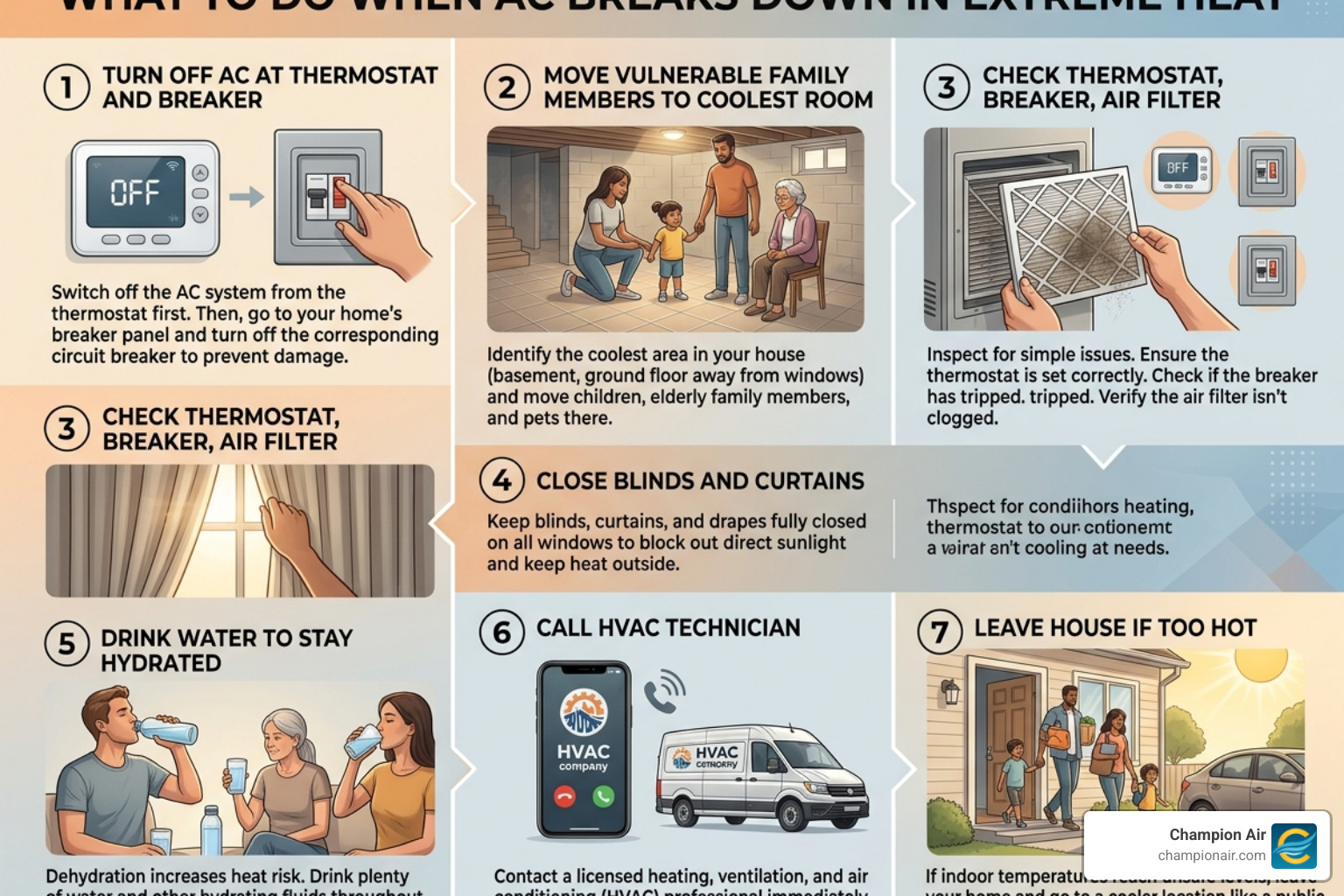
- Turn off your AC at the thermostat and the breaker to prevent further damage.
- Move vulnerable family members (elderly, infants, pets) to the coolest room in the house.
- Check the basics — thermostat settings, circuit breaker, and air filter.
- Block out the sun by closing blinds and curtains throughout your home.
- Stay hydrated — drink 2 to 4 glasses of water every hour.
- Call a licensed HVAC technician for emergency service as soon as possible.
- Leave the house if indoor temperatures climb above 85°F and show no sign of dropping.
When temperatures in Phoenix regularly push past 110°F in summer, a broken AC stops being an inconvenience within minutes. It becomes a genuine health emergency. Extreme heat claimed around 12,000 lives across the U.S. between 2010 and 2020 — more than any other weather-related hazard — and Arizona homeowners face some of the most punishing conditions in the country. Indoor temperatures can rise 10 to 20 degrees in a single hour once your system goes down, and once the thermometer inside your home crosses 85°F, the clock starts ticking for anyone who is elderly, very young, or has a health condition.
I'm Barry Farah, and as the leader of one of Arizona's largest residential HVAC companies, I've helped countless Arizona families navigate exactly what to do when your ac breaks down in extreme heat — from quick troubleshooting steps to keeping a household safe while waiting for a technician. In the sections below, I'll walk you through everything you need to know, in the order you need to know it.
In April 2026, we are already seeing the effects of a warming climate, with around 4,000 new temperature records set recently. How Hot Does Phoenix Get in the Summer? is a question we answer every year, but the reality is that when it hits 98°F or higher outside, a total system failure is an immediate emergency.
What to do when your ac breaks down in extreme heat
When the air stops moving, the first thing you must do is manage the safety of everyone inside. In the Valley of the Sun, your home can quickly become a "solar oven." According to the CDC, extreme heat was linked to over 11,000 deaths and approximately 120,000 emergency room visits in the U.S. in 2023 alone.
Hydration is your first line of defense. You should drink 2 to 4 glasses of water every hour during excessive heat, even if you don't feel thirsty. Avoid sugary or caffeinated drinks, which can actually speed up dehydration.
If anyone in your home develops a body temperature above 103°F, you are no longer dealing with an HVAC problem—you are dealing with a medical emergency. Call 911 immediately. We generally advise that if your home exceeds 85°F indoors, it is often safer to relocate vulnerable populations to a cooler location.
What to do when your ac breaks down in extreme heat to protect vulnerable family members
Even an indoor temperature of 80°F can be considered excessive heat for pets, immunocompromised or chronically ill people, the elderly, and babies. Infants and young children are particularly at risk because their bodies don't regulate temperature as efficiently as adults.
| Condition | Symptoms to Watch For | Action Required |
|---|---|---|
| Heat Exhaustion | Heavy sweating, weakness, cool/clammy skin, fast pulse, nausea. | Move to a cool place, sip water, use cool cloths. |
| Heat Stroke | Body temp >103°F, hot/red/dry skin (no sweating), confusion, dizziness. | Call 911 immediately. This is life-threatening. |
For our furry friends, pets can't tell us when they are overheating. Provide them with plenty of cool water and move them to the lowest level of the house. If you are in need of Emergency HVAC services, don't wait until someone shows signs of distress.
Relocating to cooling centers in the North Valley
If you live in Phoenix, Scottsdale, or Mesa and your AC goes out during the day, you don't have to suffer in silence. Many public libraries, community centers, and hydration stations act as official cooling centers.
If you must stay home, use a ground-floor strategy. Since hot air rises, the lowest level of your home—or a north-facing room—will stay the coolest for the longest period. If you are a tenant with a disability and your landlord is delaying repairs during a heatwave, you may have legal protections. In many jurisdictions, total AC failure in extreme heat is considered a "habitability" issue that requires immediate action. For more on handling these situations, check out Phoenix After Dark: Your Guide to 24/7 Emergency Repairs.
Is there a way to fix my AC myself before calling a technician?
Before you panic, there are a few "low-hanging fruit" items you can check. We often find that Why is AC Not Cooling? can sometimes be answered by a simple oversight.
What to do when your ac breaks down in extreme heat: Quick DIY troubleshooting
- The Thermostat: It sounds simple, but check the batteries. A dead screen or a dim display can mean your thermostat isn't sending the "cool" signal to your unit. Try a hard reset by removing the batteries for 60 seconds.
- The Circuit Breaker: Check your electrical panel. If the AC breaker has tripped, reset it once. If it trips again immediately, do not keep flipping it—you likely have a serious electrical short or a failing component.
- The Outdoor Unit: Ensure there isn't a pile of leaves, a bird's nest, or desert debris clogging the fins. Your system needs at least two feet of clearance to "breathe" and release heat.
- The Power Switch: Most indoor units have a toggle switch that looks like a light switch. Sometimes these get flipped by accident while reaching for something in a closet or attic.
Did you know that about 80% of the time an AC goes out, it's actually the capacitor? While a professional should handle the replacement, knowing Why AC Fan Not Spinning? often leads back to this small, cylindrical part that helps start the motor.
Checking for frozen coils and dirty filters
The single most common reason for an AC shutdown in the desert is a dirty air filter. In dusty areas like Scottsdale and Peoria, air filters should be checked every 30 days during the summer. A clogged filter restricts airflow, which can cause the evaporator coils to drop below freezing.
If you see ice on the copper lines or the indoor unit, your system is "frozen."
- Step 1: Turn the system to "OFF" but turn the "FAN" setting to "ON."
- Step 2: Wait. It can take 2 to 4 hours (or even up to 24 hours in high humidity) for the ice to melt.
- Step 3: Change the filter.
Do not try to run the AC while it is frozen; you could cause permanent damage to the compressor, which is a very expensive repair. If you see water pooling, see our guide on What to Do When Water Drips from Air Conditioner.
How can I keep my house cool in Scottsdale while waiting for a repair?
While you wait for a technician from AC Repair Phoenix, your goal is to turn your home into a "thermal fortress."
Block the Solar Heat: Close every blind, shade, and curtain. Up to 60% of heat enters through windows during peak cooling periods. If you have south- or west-facing windows, these are your biggest enemies during an Arizona afternoon. Properly sealed attic insulation can prevent up to 40% of heat from escaping (or entering), but in an emergency, heavy blankets hung over windows can work wonders.
Creating a "thermal fortress" in one room
Instead of trying to keep the whole house cool, pick one room to isolate.
- Choose a room on the lowest floor, preferably north-facing.
- Keep the door closed to trap the residual cool air.
- Avoid heat-generating appliances. Do not use the oven, stove, or dryer. Even large TVs and computers can raise the temperature of a small room. Eat cold meals like sandwiches or salads to keep the internal temperature down.
Using fans and ice for temporary relief
Fans don't actually lower the room temperature, but they create a windchill effect that can make you feel about 4 degrees cooler.
- Counterclockwise Rotation: Ensure your ceiling fans are spinning counterclockwise to push air straight down.
- The Ice Trick: Place a large bowl of ice or frozen water bottles in front of a box fan. This creates a DIY swamp cooler effect that provides a much cooler breeze than a fan alone.
- Pulse Point Cooling: To lower your body temperature quickly, apply cold compresses or ice packs to your "pulse points"—wrists, neck, temples, and behind the knees.
If you suspect your system is struggling due to a lack of "juice," learn the Signs Your Air Conditioner is Low in Freon.
Frequently Asked Questions about AC Emergencies
Is it a legal emergency if my AC goes out in Arizona?
In Arizona, particularly in cities like Phoenix and Scottsdale, the law recognizes that extreme heat is a life-safety issue. While specific "legal emergency" definitions can vary by city ordinance, most landlords are required to provide a "habitable" environment. When temperatures exceed 85°F indoors, it is generally expected that repairs be initiated immediately. For a deeper dive into your rights and what to expect from a service visit, see The Ultimate Phoenix Emergency Repair Service Handbook.
How long can I safely stay in a house without AC?
This depends entirely on the outdoor temperature and your health. If it is 110°F outside, a well-insulated home might stay safe for 3 to 5 hours. However, if the indoor temperature hits 90°F, the risk of heatstroke increases sharply. We recommend having a "go-bag" ready and a plan to stay with friends or at a hotel if your indoor thermometer passes 85°F. You can find more tips on staying calm in our post: Don't Panic: Here Are the Best Emergency Repair Services in Phoenix AZ.
Should I turn my AC off if it’s blowing warm air?
Yes. If your AC is running but the air coming out of the vents is warm, turn it off at the thermostat. Forcing a struggling system to work overtime when it has a mechanical failure can lead to compressor failure—a repair that can cost thousands. If you notice a burning smell, hissing, or loud buzzing, shut the power off at the breaker immediately. These are often Strange HVAC Noises You Can't Ignore.
Conclusion
Facing an AC breakdown in the middle of a desert summer is stressful, but having a plan makes all the difference. By taking immediate safety steps, performing basic troubleshooting, and knowing when to call in the pros, you can protect your family and your home.
At Champion Air, we know that an AC failure in Phoenix isn't just a nuisance—it’s an emergency. That’s why we offer 24/7 emergency repairs with no overtime charges and same-day service across the Valley, from Anthem to Queen Creek.
As we look toward the future, national refrigerant standards are changing in 2025, which may increase the cost of system replacements. If your unit is 10-15 years old, a major breakdown might be a sign that it’s time to consider a modern, high-efficiency upgrade. The best way to prevent a crisis is a spring tune-up to catch small issues before they become 115-degree nightmares.
Don't wait for the heat to win. If you're currently wondering what to do when your ac breaks down in extreme heat, give us a call or visit our Emergency HVAC page right now. We’re here to bring the cool back to your Arizona home.
Talk to a Champion
Have an HVAC question — or a quote you're not sure about?
Our free second opinion reviews any competitor quote line by line, and our team answers Valley HVAC questions every day. No pressure, no obligation — that's the Champion Air promise.
Talk to a Champion
Free Second Opinion
Already have a quote? We review it line by line, free. If it's fair, we'll tell you to take it.
About the Author
Champion Air
More Articles
View All PostsKeep Reading
Related Articles


Ready to Get Started?
Whether you need a repair, maintenance, or a new installation, our expert team is here to help.