Smart Ways to Cool Your Home When the Desert Tries to Bake You
Champion Air
Learn how to help your ac during a phoenix area heat wave: supercool, maintain filters, seal ducts & more for reliable cooling.
When Phoenix Heat Becomes Your AC's Worst Enemy
How to help your AC during a Phoenix area heat wave is one of the most important things a homeowner in the Valley can know — and in May 2026, with temperatures already pushing past 110°F, it has never been more urgent. Here is a quick-reference summary to get you started:
Quick Ways to Help Your AC Survive a Phoenix Heat Wave:
- Set your thermostat to 78°F when you are home — do not crank it lower expecting faster cooling
- Pre-cool your home in the early morning before peak heat (3 PM–7 PM) hits
- Change your air filter every 30 days during summer — desert dust clogs filters fast
- Close blinds and curtains on south- and west-facing windows during daylight hours
- Clear at least 2 feet of space around your outdoor condenser unit
- Set fans to spin counter-clockwise to push cool air down toward you
- Raise the thermostat to 85°F when you leave — never turn it off completely
- Watch for warning signs like ice on refrigerant lines or warm air from vents
- Schedule professional maintenance before the peak season hits
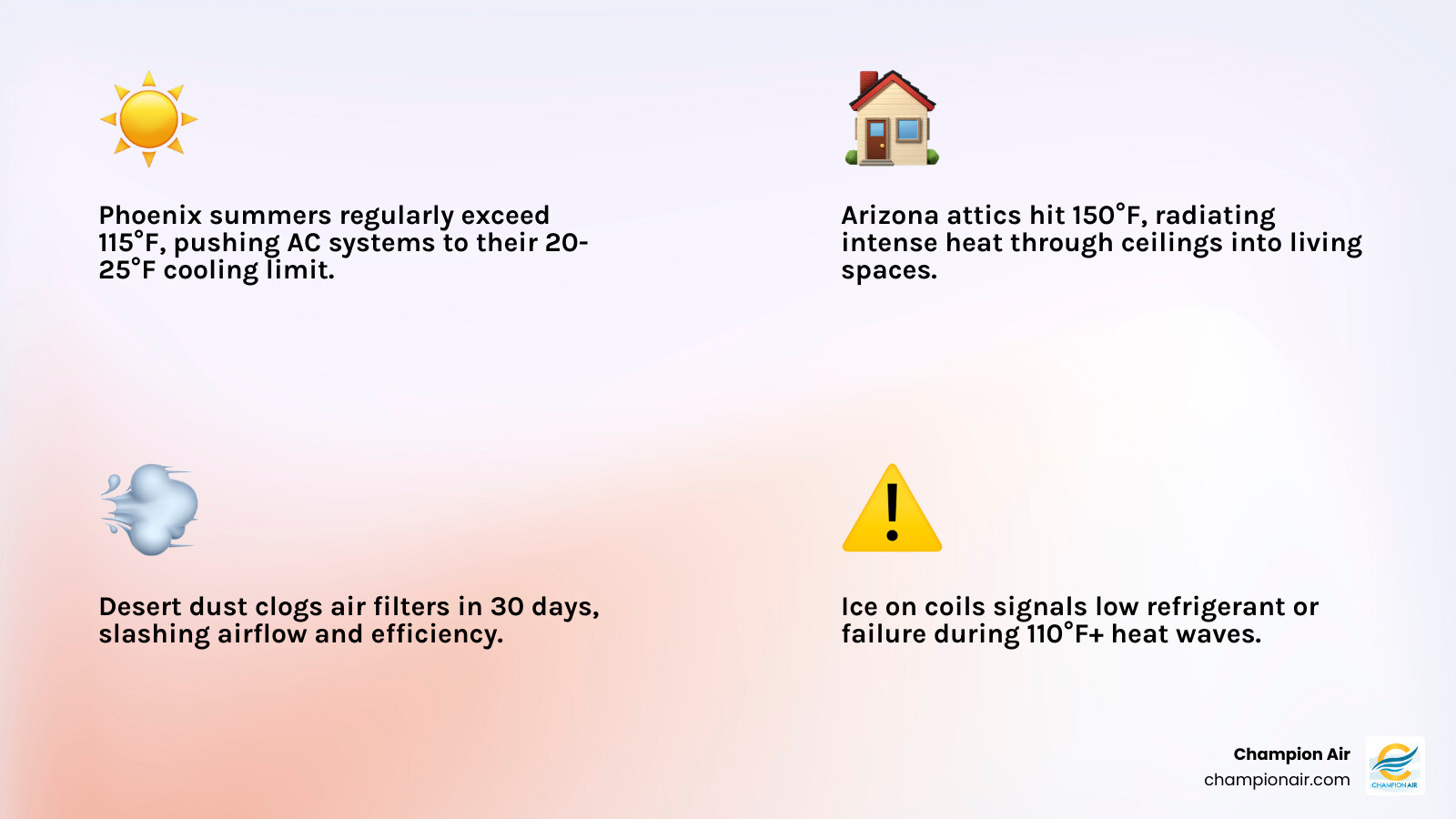
Most Phoenix homeowners assume that if the AC is running, the house should be as cool as they want it to be. But your system is fighting a battle against physics every single day of a desert summer. When outdoor temperatures exceed 110°F or 115°F, even a perfectly functioning AC unit can only do so much. Most residential systems are engineered to maintain indoor temperatures roughly 20 to 25 degrees cooler than the outside air — that is a hard physical limit, not a flaw in your equipment. When it is 115°F outside, expecting your home to reach 68°F is simply asking more than the system was ever designed to deliver.
Add to that the fact that Arizona attics routinely exceed 150°F in summer, sending waves of heat down through your ceilings and into your ductwork. Cooling accounts for up to 50% of summer energy bills in the Phoenix area. And with a record 155 heat-related deaths reported in Arizona last summer — many of them inside homes — keeping your AC running efficiently is not just a comfort issue. It is a safety issue.
The good news? There is a lot you can do — right now — to reduce the load on your system, spot trouble early, and keep your home livable all the way through the worst of a Phoenix heat wave.
I am Barry Farah, and as the leader of one of Arizona's largest family-owned residential HVAC companies, I have spent years helping Valley homeowners understand how to help their AC during a Phoenix area heat wave — before a breakdown turns into a crisis. Let me walk you through exactly what works.
How to Help Your AC During a Phoenix Area Heat Wave
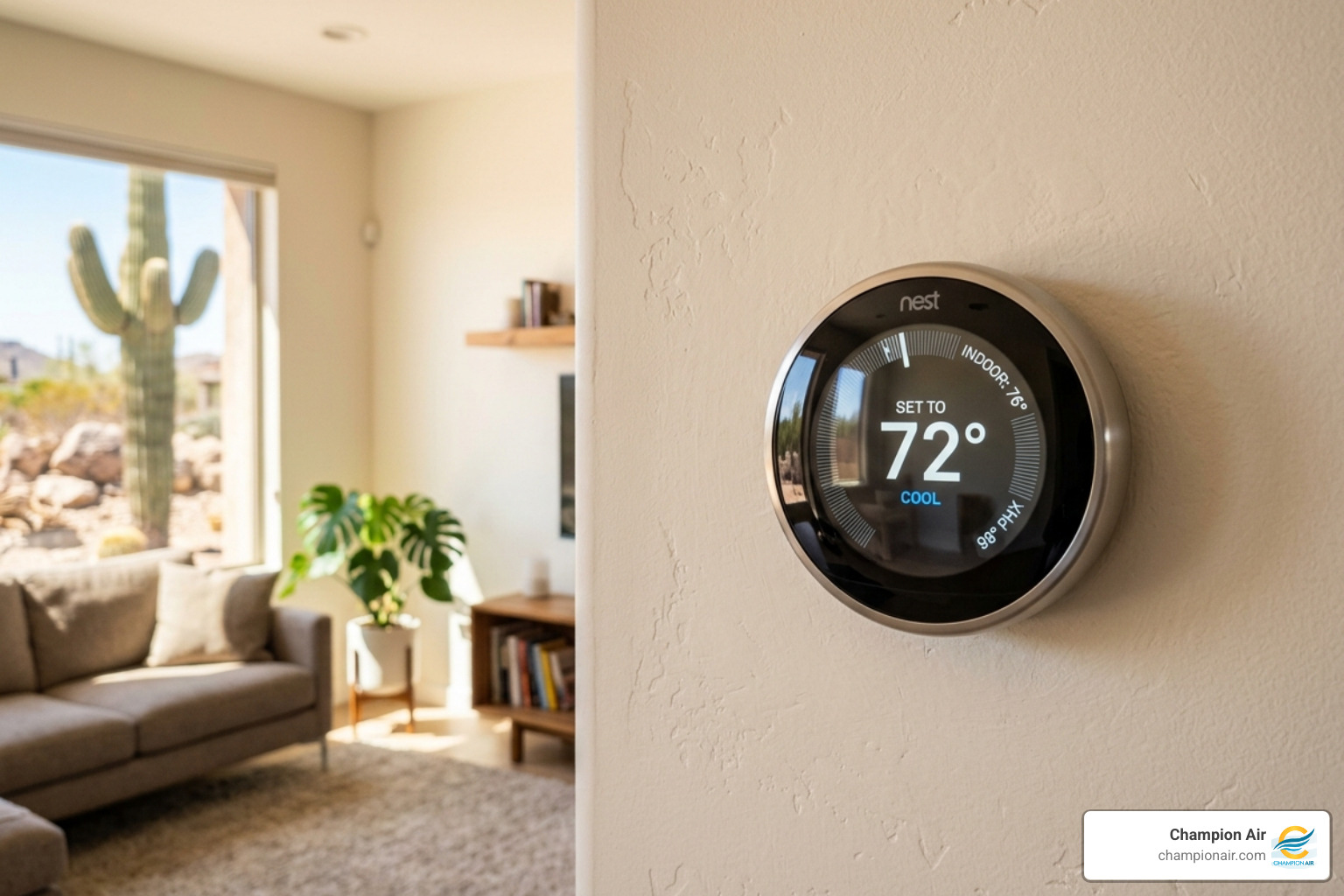
To truly understand how to help your AC during a Phoenix area heat wave, we have to talk about "Design Temperature." Most people think of their thermostat like a steering wheel—turn it further, and you get more results. In reality, a thermostat is just a light switch. Setting it to 65°F when it’s 115°F outside doesn't make the air coming out of the vents any colder; it simply tells the compressor to run forever because it will never reach that goal.
In our region, HVAC systems are typically designed to handle a 20- to 25-degree temperature differential. This means if the Phoenix summer heat is screaming at 115°F, a healthy system might only be able to pull the indoor air down to 90°F or 85°F during the hottest part of the afternoon. If your home stays at 80°F during a record-breaking spike, your AC isn't necessarily failing—it's actually performing at the top of its class.
When you understand why your AC is not cooling to your usual preference, you can stop stressing the system by "cranking" the dial, which only leads to frozen coils and blown capacitors.
How to help your ac during a phoenix area heat wave with supercooling
One of the most effective strategies we recommend at Champion Air is "supercooling" (also known as pre-cooling). This technique turns your home into a "thermal battery."
The concept is simple: you use the cooler morning hours to chill the physical structure of your home—the walls, the floors, and the furniture.
- The Morning Chill Phase: Between midnight and 10:00 AM, drop your thermostat to 70°F or 72°F. This is when electricity is often cheaper and the outdoor unit can release heat much more efficiently.
- The Afternoon Coasting Phase: Around 10:00 AM or 11:00 AM, raise the thermostat to 78°F or 80°F. Because your home’s "thermal mass" is already cold, the AC won't have to work nearly as hard during the 3:00 PM to 7:00 PM peak heat window.
By prepping your HVAC system for summer with this schedule, you reduce the mechanical strain on the compressor during the hottest part of the day. If you've ever wondered how long your AC should run in Arizona, supercooling helps ensure it isn't running 24/7 at maximum pressure when the sun is at its peak.
How to help your ac during a phoenix area heat wave through professional care
While DIY habits are great, some things require a pro. During a heat wave, your AC’s internal components are under immense pressure. Think of it like a marathon runner; if they are dehydrated (low refrigerant) or have a weak heart (a failing capacitor), they will collapse before the finish line.
- Refrigerant Levels: If your system is even slightly low on refrigerant, the pressure drops, causing the temperature of the indoor coil to plummet until it freezes into a block of ice.
- Capacitor Health: These small parts provide the "kickstart" for your motors. Heat is the number one killer of capacitors. A professional tune-up can identify a bulging or weak capacitor before it fails on a Sunday afternoon.
- Off-Peak Scheduling: Don't wait for July. Scheduling your AC maintenance & tune-up in Phoenix during the "shoulder months" of March or April ensures your system is ready for the first 110-degree day.
Proactive care is one of our top tips for extending the lifespan of your air conditioner, as it prevents the "acidic oil" breakdown that occurs when compressors overheat.
Maintenance and Red Flags: Keeping the Air Flowing
Airflow is the lifeblood of your cooling system. In the desert, we deal with "haboobs" (dust storms) and constant wind-blown grit. This makes changing air filters extremely important. During the peak of a Phoenix summer, you should check your filter every 30 days. If you have pets or live near new construction in areas like Buckeye or Surprise, you might even need to change it every three weeks.
A dirty filter acts like a chokehold on your AC. It forces the blower motor to work harder, which generates more heat, which eventually leads to a system shutdown. Similarly, your outdoor condenser unit needs to "breathe" to release the heat it pulled from your house. Ensure there is at least two feet of clearance around the unit—no bushes, no storage bins, and no decorative fences blocking the airflow. Learning how to clean your air conditioner by gently hosing off the outdoor fins can improve efficiency by up to 10% instantly.
Identifying Warning Signs of System Failure
It can be hard to tell if your AC is just "struggling" with the 115°F heat or if it is actually breaking. Use this guide to know when to call for AC repair service in Phoenix.
| Symptom | Is it Normal in 115°F Heat? | Action Required |
|---|---|---|
| Indoor temp is 78°F while set to 75°F | Yes, if it's mid-afternoon. | Close blinds and wait for sunset. |
| Ice forming on copper lines | NO. This is a major red flag. | Turn off AC immediately; call for repair. |
| AC runs for 45 minutes straight | Yes. Long cycles are normal in extreme heat. | Monitor for cooling performance. |
| Grinding or squealing noises | NO. This indicates motor or bearing failure. | Call for emergency HVAC repair. |
| Warm air coming from vents | NO. Could be a failed compressor or capacitor. | Check breakers, then call a pro. |
If you see ice, stop! Running an AC with frozen coils can cause liquid refrigerant to flood back into the compressor, which can permanently destroy the unit. Turn the system to "Off" but keep the "Fan" setting to "On" to help the ice melt safely while you wait for a technician.
Simple Household Habits to Reduce Load
You can significantly help your AC during a Phoenix area heat wave just by changing how you live inside your home.
- Window Treatments: Solar screens or heavy "blackout" curtains can block up to 70% of solar heat gain. If the sun is hitting a window, that curtain should be closed.
- Appliance Timing: Your oven, dishwasher, and dryer are giant heaters. Avoid using them between 2:00 PM and 8:00 PM. Grilling outside or using a microwave can keep your indoor temp several degrees lower.
- Ceiling Fan Direction: Ensure your fans are spinning counter-clockwise. This creates a "wind-chill effect" on your skin. While fans don't actually lower the room temperature, they allow you to feel comfortable at a thermostat setting that is 4°F higher, saving you big on energy bills.
Fortifying Your Home: Insulation and Ductwork
If your AC is the "engine," your home’s insulation is the "body." In cities like Scottsdale and Mesa, many older homes have insulation that has settled or thinned over time. Since Arizona attics can reach a blistering 150°F, that heat is constantly trying to push into your living space.
Properly sealed attic insulation can prevent up to 40% of heat gain. Furthermore, your ductwork often lives in that 150°F attic. If your ducts are unsealed or poorly insulated, you can lose up to 30% of your cooled air before it ever reaches your bedroom.
High-Impact Home Efficiency Upgrades:
- Duct Sealing: Using mastic or foil tape to seal leaks ensures the air you pay to cool actually reaches you.
- Radiant Barriers: These reflective foils in the attic can reduce solar heat absorption by up to 60%.
- Correct Sizing: If your AC is too small, it will never keep up. If it's too large, it will "short-cycle," turning on and off so fast that it never removes the humidity, leaving you feeling "clammy" even if the air is cool.
Frequently Asked Questions about Phoenix Heat Waves
Why is there ice on my AC unit when it is 115°F outside?
It seems like a paradox, but ice usually forms because of restricted airflow (a filthy filter) or a refrigerant leak. When the pressure in the system drops too low, the coils get so cold that the moisture in the air freezes instantly on contact. If you see ice, turn the unit off immediately to prevent compressor damage.
Should I turn my AC off completely when I leave for work?
No. This is a common mistake. If you turn the AC off, the "thermal mass" of your home (the walls and slab) will heat up to 90°F or more. When you get home and turn it back on, the AC has to work for hours just to remove the heat from the furniture and walls before the air feels cool. Instead, raise the thermostat by 7-10 degrees (to about 82°F or 85°F).
How often should I change my air filters during a record-breaking summer?
During a heat wave, your AC runs significantly more than usual, meaning it processes much more dust. We recommend checking your filter every 30 days. If it looks grey or fuzzy, replace it. A clean filter is the cheapest way to prevent a $500 repair bill.
Conclusion
Surviving a Valley summer is all about strategy. By understanding the limits of your system, using supercooling to your advantage, and keeping up with basic maintenance like filter changes, you can stay comfortable even when the desert is at its most unforgiving.
At Champion Air, we are proud to serve our neighbors in Scottsdale, Phoenix, Mesa, and throughout the surrounding areas—from Anthem to Queen Creek. Our licensed technicians are experts in the unique demands of the Arizona climate, offering 24/7 emergency support with no overtime charges. Whether you need a quick tune-up or a complex repair, we are here to ensure your home remains a sanctuary.
Schedule your professional cooling service today and let us help you beat the heat!
Talk to a Champion
Have an HVAC question — or a quote you're not sure about?
Our free second opinion reviews any competitor quote line by line, and our team answers Valley HVAC questions every day. No pressure, no obligation — that's the Champion Air promise.
Talk to a Champion
Free Second Opinion
Already have a quote? We review it line by line, free. If it's fair, we'll tell you to take it.
About the Author
Champion Air
More Articles
View All PostsKeep Reading
Related Articles


Ready to Get Started?
Whether you need a repair, maintenance, or a new installation, our expert team is here to help.