How a Heat Pump Works in Arizona Weather
Champion Air
Learn how a heat pump works in Arizona weather to stay comfortable year-round in Phoenix desert heat and mild winters.
How a Heat Pump Works in Arizona Weather
What Arizona Homeowners Need to Know About Heat Pumps Before Summer Hits
Understanding how a heat pump works in Arizona weather is the fastest way to know if this technology is the right fit for your home. Here is a quick answer:
How a heat pump works in Arizona weather — at a glance:
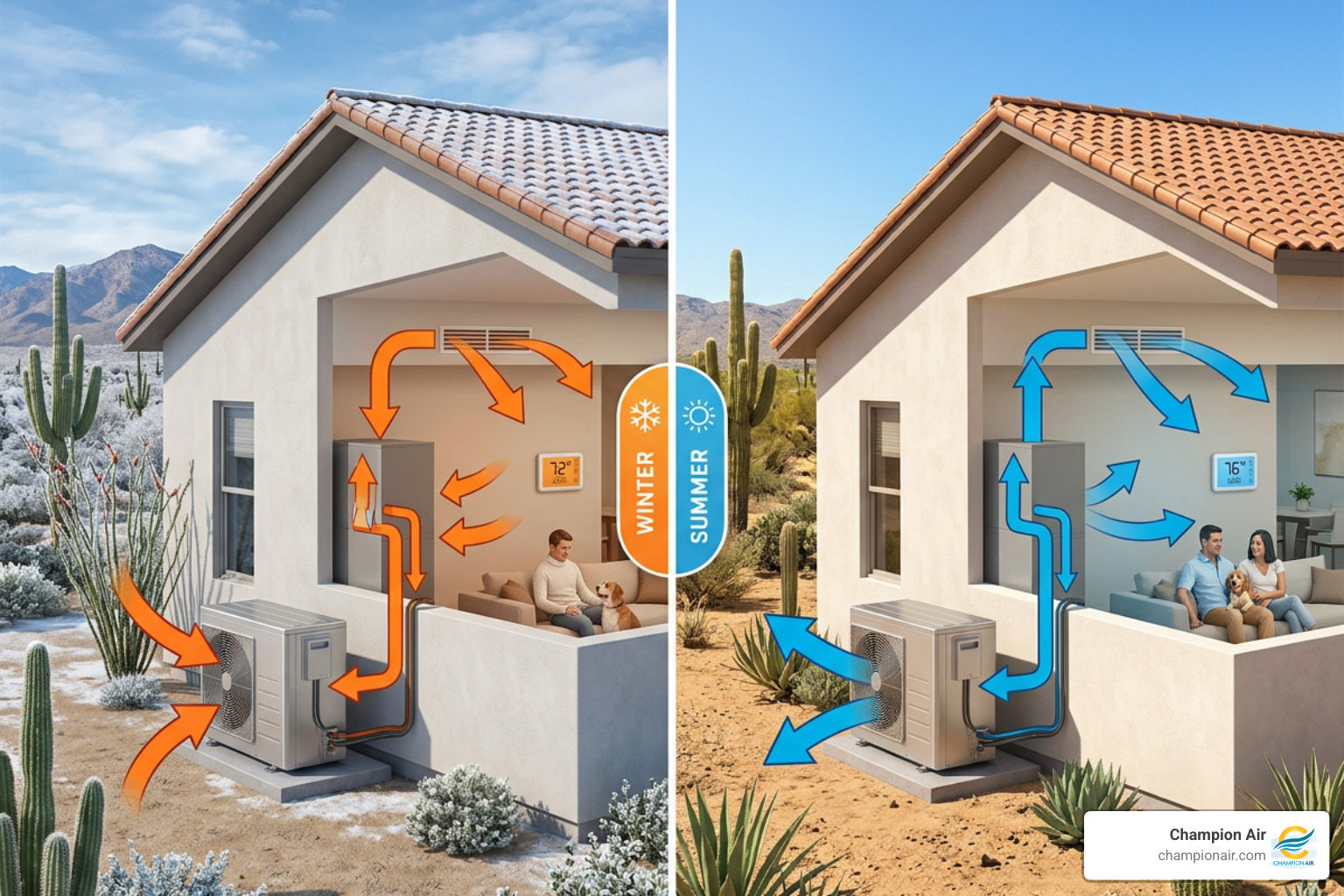
- Summer (cooling mode): The heat pump pulls heat from inside your home and moves it outdoors — exactly like a traditional air conditioner.
- Winter (heating mode): A component called a reversing valve flips the refrigerant flow, pulling warmth from the outdoor air and moving it inside to heat your home.
- Year-round efficiency: Because Arizona winters are mild, the heat pump rarely struggles to find outdoor heat — making it highly efficient all year long.
- One system, two jobs: A single heat pump replaces both your air conditioner and your furnace.
- Desert-ready technology: Modern inverter-driven heat pumps maintain cooling capacity even when Phoenix temperatures exceed 110°F.
If you live in the Phoenix Valley, Scottsdale, or Mesa, a heat pump is not just a viable option — for many homeowners, it is the smartest HVAC investment available. Arizona's long, brutal summers and short, mild winters create near-perfect conditions for heat pump technology to shine. Yet many homeowners still scratch their heads at the name, wondering how a device called a "heat pump" could possibly keep a home cool when it is 115°F outside.
The short answer: it can, and it does it well. The longer answer involves a fascinating process of moving heat rather than creating it — and that distinction is exactly what makes heat pumps so efficient in a desert climate.
I'm Barry Farah, and leading Arizona's largest Lennox family-owned residential HVAC replacement company has given me a front-row seat to how a heat pump works in Arizona weather across thousands of Valley homes. In the sections below, I'll walk you through everything you need to make a confident decision for your home.
How a heat pump works in arizona weather helpful reading:
The Science of Desert Comfort: How a Heat Pump Works in Arizona Weather
To understand how a heat pump keeps your home comfortable in the extreme conditions of the Southwest, you have to throw out the idea that heating and cooling are two completely different processes. In reality, they are two sides of the same coin.
At its core, a heat pump uses the vapor-compression refrigeration cycle to relocate thermal energy. It relies on the second law of thermodynamics: heat naturally flows from a warmer area to a cooler area. By manipulating the pressure and physical state of a chemical refrigerant, a heat pump forces heat to move exactly where we want it to go, even when that direction goes against nature.
The magic component that allows a heat pump to act as both an air conditioner and a heater is the reversing valve. In a standard air conditioner, refrigerant flows in only one direction. In a heat pump, the reversing valve acts like a high-tech traffic cop, physically redirecting the flow of hot refrigerant gas.
When you want to understand the practical differences and benefits of this dual functionality, it helps to read our guides on Why Desert Homeowners Are Trading Their Old ACs for Heat Pumps and Choosing Air Conditioners vs Heat Pumps.
Cooling Mode: How a Heat Pump Works in Arizona Weather During Summer
During a scorching July afternoon in Phoenix, Tempe, or Peoria, a heat pump operates exactly like a conventional central air conditioner.
- Heat Extraction: Hot indoor air is pulled across your indoor evaporator coil by the blower fan.
- Refrigerant Absorption: Cold, low-pressure liquid refrigerant circulating inside the coil absorbs the heat from your indoor air. As it absorbs this heat, the refrigerant boils and evaporates into a low-pressure gas.
- Compression: This gas travels outdoors to the compressor, which squeezes the refrigerant, raising its temperature and pressure significantly.
- Heat Rejection: The hot, high-pressure gas enters the outdoor condenser coil. The outdoor fan blows hot air across the coils, transferring the heat from the refrigerant into the outdoor air. Because the pressurized refrigerant is even hotter than the 115°F desert air, thermodynamics dictates that the heat must escape outdoors.
- Expansion: Having lost its heat, the refrigerant condenses back into a liquid, passes through an expansion valve to drop its pressure and temperature, and heads back indoors to start the cycle again.
Because this is the exact same process used by a standard AC, you can rest assured that a heat pump is exceptionally good at cooling. To learn more about how these systems hold up when the asphalt is melting, check out our article on Are Heat Pumps Efficient in Extreme Heat.
Heating Mode: How a Heat Pump Works in Arizona Weather During Winter
When the sun goes down and winter nights drop into the 40s in Chandler, Gilbert, or Queen Creek, you need reliable heating. This is where the reversing valve earns its keep.
With a quick click of your thermostat, the reversing valve slides into its heating position, reversing the path of the refrigerant:
- Outdoor Heat Absorption: The outdoor coil now acts as the evaporator. Even when it feels cold to us outside, there is still a massive amount of ambient thermal energy in 45°F air. The cold refrigerant absorbs this heat and vaporizes.
- Compression: The compressor squeezes this gas, raising its temperature to well over 100°F.
- Indoor Heat Release: The hot gas is pumped indoors to the indoor coil (which now acts as the condenser). Your indoor blower fan forces air across the hot coil, heating your home.
- Return Loop: The refrigerant condenses back into a liquid and travels back outdoors to collect more heat.
Because heat pumps simply move heat rather than generate it through combustion (like a gas furnace) or electrical resistance (like a space heater), they are incredibly efficient. In fact, they can deliver 1.5 to 3 times more heat energy than the electrical energy they consume. In our mild desert winters, a heat pump operates in its absolute sweet spot, making it a highly practical upgrade. For a deeper look at why our local climate is so perfect for this technology, read Why Your Mild Winter Climate Makes a Heat Pump a No-Brainer.
Selecting the Right Heat Pump Type for the Phoenix Valley
Every home in the Valley is unique. A historic home in downtown Phoenix has different heating and cooling needs than a sprawling new build in Scottsdale or a master-planned property in Surprise. Fortunately, heat pump technology is highly versatile.
When choosing a system, we typically look at four main categories:
- Standard Air-Source Heat Pumps: These are ducted systems that connect directly to your home’s existing ductwork, making them an easy, drop-in replacement for a traditional split AC and furnace setup.
- Ductless Mini-Split Heat Pumps: Perfect for homes without existing ductwork, guest houses, casitas, or hard-to-cool rooms (like a converted garage or a west-facing bedroom). They use an outdoor condenser connected to one or more elegant, wall-mounted indoor air handlers. Ductless systems are incredibly efficient because they avoid the 30% energy loss typically associated with leaky ductwork.
- Variable-Speed Inverter Heat Pumps: Traditional heat pumps are either 100% on or completely off. Variable-speed models use advanced inverter technology to modulate their output anywhere from 30% to 100%. This allows them to run almost continuously at lower, highly efficient settings, maintaining a rock-steady indoor temperature and reducing peak energy demand by 30-50% during summer heatwaves.
- Geothermal Heat Pumps: These systems exchange heat with the ground rather than the air. Because soil temperatures at six feet deep remain a stable 68°F to 72°F in the Phoenix Basin year-round, geothermal systems are incredibly efficient. However, they require extensive underground piping loops.
To help you visualize which system might fit your home best, we have put together this comparison table:
| System Type | Best Suited For | Key Advantage | Efficiency Potential |
|---|---|---|---|
| Ducted Air-Source | Homes with existing, well-maintained ductwork | Lower initial installation complexity | High (Up to 20 SEER2) |
| Ductless Mini-Split | Casitas, home additions, zone-based heating/cooling | Zero duct loss; independent room control | Ultra-High (Up to 30 SEER2) |
| Variable-Speed Inverter | Maximum comfort, low utility bills, quiet operation | Modulates output to match exact cooling load | Excellent (Over 20+ SEER2) |
If you want to read more about how these options compare, take a look at our detailed breakdown, Heat Pumps Perfect for Arizona.
Understanding Desert Efficiency Ratings: SEER2, HSPF2, and COP
When shopping for a heat pump in Arizona, you will run into several acronyms that measure how much bang you get for your buck. Understanding these numbers is crucial for choosing a system that will keep your utility bills low.
- SEER2 (Seasonal Energy Efficiency Ratio 2): This measures cooling efficiency over a typical cooling season. In our hot climate, SEER2 is the most critical rating. The federal minimum for split-system heat pumps in the Southwest region is 15.2 SEER2, but high-efficiency models can reach 20 to 30 SEER2. Upgrading to a modern system can deliver up to 40% energy savings compared to older, outdated units.
- HSPF2 (Heating Seasonal Performance Factor 2): This measures heating efficiency over a typical winter. A higher HSPF2 means lower winter heating bills. While heating is a smaller portion of our annual utility usage in the Valley, a high HSPF2 still pays dividends on chilly winter nights.
- COP (Coefficient of Performance): This is a real-time measurement of efficiency. A COP of 4.0 means the system delivers 4 units of heat energy for every 1 unit of electricity it consumes (representing 400% efficiency).
To put this in perspective, let's look at heating costs. A high-efficiency gas furnace might achieve a 97% efficiency rating, while standard electric resistance heaters operate at 100% efficiency (COP of 1.0). A heat pump with an 8.5 HSPF rating can deliver heat at a fraction of the cost:
- Electric Resistance Heat: $36.25 per 1,000,000 BTUs
- Gas Furnace: $16.98 per 1,000,000 BTUs
- Heat Pump (8.5 HSPF): $15.09 per 1,000,000 BTUs
In Arizona, heat pumps can be up to 30% less expensive year-round to run compared to gas furnaces. If you want to dive deeper into how these ratings impact your installation choices, read our guide Everything You Need to Know About Residential Heat Pump Installation.
Maintaining Your Heat Pump for Peak Performance in Extreme Heat
Because a heat pump provides both heating and cooling, it works hard all year long. In the Phoenix Valley, where blowing dust, extreme summer heat, and monsoon storms are the norm, regular maintenance is absolutely critical to keep your system running smoothly and efficiently.
Here are the most important DIY and professional maintenance tasks you should stay on top of:
- Replace Filters Regularly: Desert dust and pet dander can clog your filters quickly. Check your air filter monthly and replace it every 1 to 3 months. During monsoon season, when dust storms (haboobs) sweep through places like Apache Junction, Queen Creek, or Avondale, you may need to change them even more frequently.
- Clear Outdoor Debris: Keep at least two feet of clear space around your outdoor unit. Trim back desert landscaping, shrubs, and weeds, and clear away any windblown trash or leaves that could restrict airflow.
- Clean the Coils: Gently rinse the outdoor condenser coil with a garden hose (with the power off) to wash away accumulated desert dust and grime.
- Schedule Professional Tune-Ups: Because your heat pump runs almost continuously, we highly recommend scheduling professional maintenance twice a year — once in the spring before the summer heat hits, and once in the fall before the winter chill sets in.
For residents in Scottsdale, Mesa, and the surrounding areas, we have put together localized guides to help you get the most out of your system:
- Heat Pump Maintenance in Mesa AZ: Your Go-To Guide for Affordable, Top-Rated Service
- Heat Pump Maintenance in Scottsdale AZ: Your Go-To for Affordable Expert Service
- Heat Pump Tune-Up Guide for Arizona Homeowners
Frequently Asked Questions About Arizona Heat Pumps
How long do heat pumps last in the Phoenix area?
Because heat pumps work year-round to provide both heating and cooling, they experience more wear and tear than a standalone furnace or AC. In the Phoenix metro area, a well-maintained heat pump typically lasts 10 to 15 years.
Factors that influence this lifespan include the quality of the initial installation, how diligently you change your air filters, and whether you schedule regular professional tune-ups. For more details on maximizing your system's life, read our article How Long Do Heat Pumps Last.
What are the signs my heat pump needs repair or replacement?
It is always best to catch HVAC issues before they turn into a complete system breakdown on a 115°F afternoon. Keep an eye out for these common warning signs:
- Lukewarm Airflow: If your system is blowing warm air in cooling mode or cool air in heating mode, it could indicate a refrigerant leak, a failing compressor, or a malfunctioning reversing valve.
- Frequent Cycling: If your system turns on and off every few minutes, it may be oversized, low on refrigerant, or experiencing airflow restrictions.
- Unusual Noises: Squealing, grinding, rattling, or loud metal-on-metal noises are clear signs of mechanical trouble.
- Spike in Utility Bills: A sudden, unexplained jump in your monthly power bill suggests your system is working much harder than it should to maintain comfort.
If you are experiencing any of these issues, consult our Heat Pump Troubleshooting Tips Before Calling a Pro guide, or reach out to us for fast, reliable Heat Pump Repair: Affordable in Phoenix AZ.
Why is there ice buildup on my heat pump during winter?
It can be startling to walk outside on a cold winter morning in Glendale or Tempe and see frost or ice coating your outdoor unit. However, a light layer of frost is actually a normal part of operation.
As the heat pump extracts heat from the outdoor air, moisture in the air condenses on the cold coils. If the outdoor temperature is near freezing, this moisture will freeze. To handle this, your heat pump has an automatic defrost cycle. Every so often, it will temporarily reverse into cooling mode to send warm refrigerant to the outdoor coils, melting the ice.
If your system is completely encased in thick ice and the defrost cycle isn't kicking in, it could be due to restricted airflow, a bad sensor, or low refrigerant levels. To learn how to handle this issue, read Heat Pump Ice Buildup: Causes and What to Do.
Conclusion
Understanding how a heat pump works in Arizona weather shows why this technology is such an outstanding fit for our desert lifestyle. By moving heat rather than generating it, a heat pump provides highly efficient cooling during our long, scorching summers and cozy warmth during our mild winters — all from a single, reliable system.
At Champion Air, we are proud to provide award-winning heating, cooling, and indoor air quality solutions across Scottsdale, Phoenix, Mesa, and surrounding Valley cities. Our licensed, experienced technicians are ready to help you find the perfect comfort solutions for your home.
Are you looking to upgrade your home's heating and cooling? Schedule your professional heat pump installation with Champion Air today to start enjoying lower utility bills and year-round peace of mind.
About the Author
Champion Air
More Articles
View All PostsKeep Reading
Related Articles


Ready to Get Started?
Whether you need a repair, maintenance, or a new installation, our expert team is here to help.