Don't Let Your Heat Pump Fan Lose Its Cool
Champion Air
Discover heat pump fan motor failure causes and repair options. Troubleshoot, prevent damage & fix fast in Phoenix heat!
Don't Let Your Heat Pump Fan Lose Its Cool
When Your Heat Pump Fan Stops Spinning: What Arizona Homeowners Need to Know
Understanding heat pump fan motor failure causes and repair options could be the difference between a quick, affordable fix and a compressor replacement that costs thousands. If your outdoor unit is running but the fan blade isn't moving, here is what is most likely happening:
Most common causes of heat pump fan motor failure:
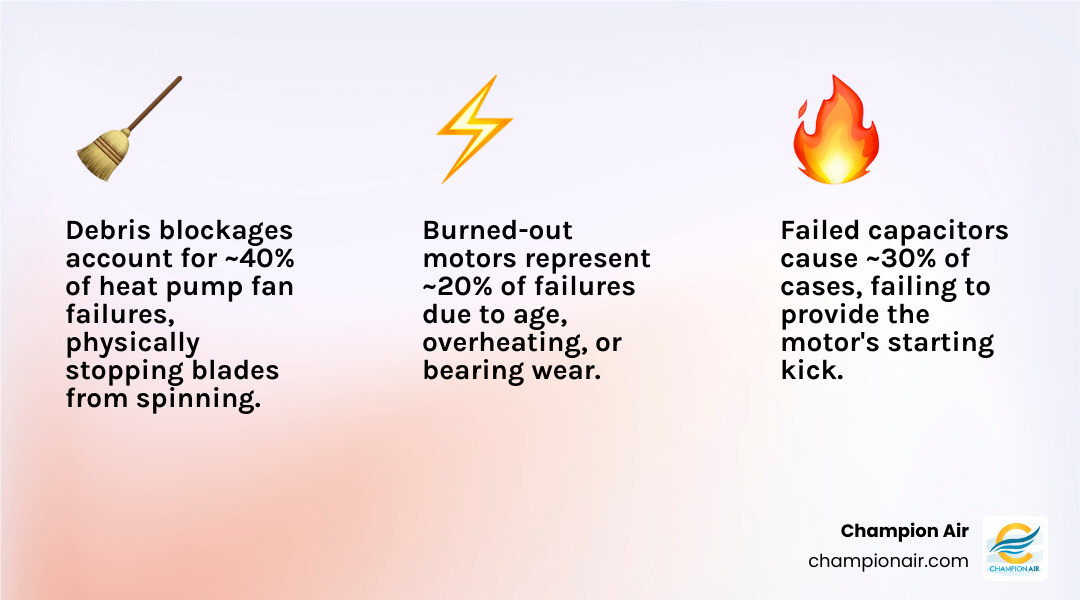
- Debris blockage - Leaves, twigs, or nesting materials physically stop the blades from spinning (accounts for roughly 40% of cases)
- Failed capacitor - The component that gives the motor its starting "kick" wears out over time (roughly 30% of cases)
- Burned-out fan motor - The motor itself fails due to age, overheating, or bearing wear (roughly 20% of cases)
- Thermostat or wiring issues - Incorrect settings or a faulty signal prevent the fan from receiving the command to run
- Tripped circuit breaker - High electrical demand, especially during Arizona summers, can trip the breaker and cut power entirely
Your immediate action: Turn the unit off at the thermostat right now if the fan is not spinning but the compressor is still running. Every minute of operation without a working fan puts your compressor at serious risk.
Arizona's extreme heat makes heat pump fan problems more urgent than they would be almost anywhere else in the country. A fan that fails during a Phoenix summer does not just mean discomfort — it can push your compressor to the breaking point within minutes. Whether you are hearing a hum with no movement, seeing the blades spin slowly, or noticing nothing is happening at all, each symptom points to a specific cause — and knowing which one you are dealing with saves time, money, and stress.
I'm Barry Farah, and leading Arizona's largest Lennox family-owned residential HVAC replacement company has given me a front-row seat to how quickly heat pump fan motor failure causes and repair options can escalate from a minor inconvenience to a major system loss when the wrong decisions are made early. In the sections below, I'll walk you through exactly how to diagnose what's going wrong and what your best options are to get your system back up and running.
Identifying Heat Pump Fan Motor Failure Causes and Repair Options
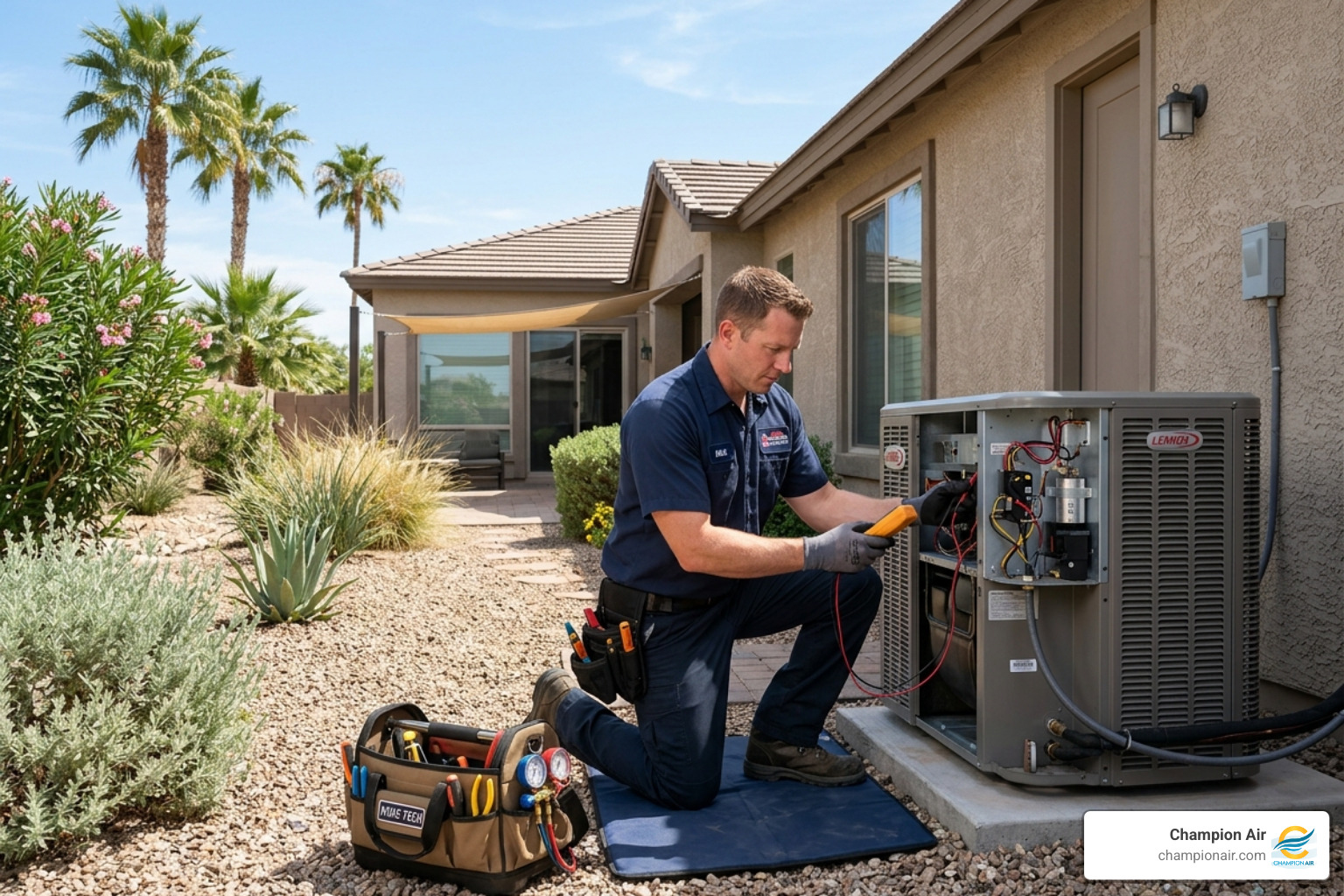
When we arrive at a home in Scottsdale or Peoria for diagnostics, the first thing we look for is why the airflow has been interrupted. In May 2026, as temperatures begin their climb toward the triple digits, a stationary fan is often the result of one of several common culprits.
Debris Blockages In the Valley, monsoon winds and desert landscaping can conspire against your HVAC system. Roughly 40% of the time, the fan isn't spinning simply because something is physically in the way. This could be a stray branch from a Palo Verde tree, a buildup of dried leaves, or even a bird’s nest. Because the fan blades are often made of lightweight aluminum, even a small twig can wedge itself between the blade and the protective grate, stalling the motor.
Failed Capacitors If you hear a persistent humming sound coming from the unit but the blades aren't moving, the capacitor is likely the issue. This small, cylindrical component acts like a battery that provides the high-voltage "kick" needed to start the motor. Capacitors are the most common electrical component to fail in Arizona because extreme heat causes them to lose their ability to hold a charge. About 30% of fan failures are traced back to a dead capacitor.
Motor Burnout The fan motor itself can fail due to age or excessive strain. If the motor is hot to the touch or smells like burning plastic, the internal windings have likely shorted out. This accounts for about 20% of failures.
Electrical and Thermostat Issues Sometimes the problem isn't the fan at all, but the signal telling it to turn on. A tripped circuit breaker—often caused by the system working overtime during a heatwave—will cut power to the entire outdoor unit. Similarly, a thermostat that has lost its connection or has dead batteries can prevent the system from engaging.
The Risks of Running a System with a Failed Fan
It is tempting to leave the system running if you are still feeling a little bit of cool air, but this is a dangerous gamble. The outdoor fan's primary job is to pull air across the condenser coils to dissipate the heat that the refrigerant has gathered from inside your home. Without that airflow, the heat has nowhere to go.
When the fan fails, the refrigerant temperature and pressure skyrocket. The compressor—the "heart" of your system—must then work twice as hard against this high pressure. This leads to rapid overheating. Most modern systems have a thermal overload switch that will shut the compressor down to prevent it from melting, but these switches aren't foolproof.
Repeatedly trying to run a system with a dead fan can lead to a "cascading failure." This is where a relatively inexpensive fan repair turns into a catastrophic compressor failure. Replacing a compressor is one of the most expensive repairs in the HVAC world, often costing three to four times more than a fan motor replacement. If your fan is down, you should treat it as an emergency and shut the power off immediately to protect your investment.
Troubleshooting Common Fan and Motor Issues
Before calling for a repair, there are a few safe steps you can take to identify the problem. Use the table below to match your system's symptoms with the likely cause.
| Symptom | Likely Cause | Repair Priority |
|---|---|---|
| Loud clicking or rattling | Debris in fan blades | High - Clear immediately |
| Humming sound, no rotation | Failed Capacitor | High - Do not run unit |
| Fan spins when pushed with a stick | Weak Capacitor/Lagging Motor | Medium - Needs professional look |
| Grinding or screeching noise | Worn Motor Bearings | Medium - Motor failing |
| No sound, no movement | Tripped Breaker/Thermostat | Low - Check electrical panel |
Diagnosing Heat Pump Fan Motor Failure Causes and Repair Options
To narrow down the issue, we recommend the "Stick Test." With the power on and the thermostat calling for cooling, take a long, thin stick (never use your hands!) and gently nudge the fan blades through the top grate. If the fan starts spinning and continues to run on its own, your motor is likely fine, but your start capacitor has failed. It needed that physical "push" because it didn't get the electrical one it required.
If you are comfortable with a multimeter, you can check the capacitor for physical signs of failure. A failing capacitor will often "mushroom" or bulge at the top. If the top is no longer flat, it is definitely dead. You can also test for continuity in the motor windings to see if the motor has burned out completely. If there is no continuity, the motor is "open" and must be replaced. For more specialized help, our Heat Pump Repair Service Phoenix Az team can perform these tests safely.
Professional Heat Pump Fan Motor Failure Causes and Repair Options
When it comes to replacement, you generally have two choices: PSC or ECM motors.
- PSC (Permanent Split Capacitor) Motors: These are the traditional, single-speed motors found in most older units. They are reliable and less expensive to replace, but they aren't very energy efficient.
- ECM (Electronically Commutated Motors): These are modern, variable-speed motors. They can speed up or slow down based on the cooling demand, which saves a significant amount of electricity. While the initial part cost is higher, the long-term energy savings in a place like Mesa or Chandler are substantial.
Choosing the right motor requires matching the horsepower, voltage, and RPM (rotations per minute) exactly. If you're curious about the differences in internal components, you can read more about Ac Blower Motor Replacement Cost for the indoor side of your system, which follows similar logic.
Maintenance Strategies for Arizona Homeowners
Prevention is always better than a mid-summer breakdown. In the desert, your heat pump faces unique challenges that systems in cooler climates don't have to deal with. Following a guide like Beat The Heat Comprehensive Heat Pump Maintenance For Phoenix Homes is a great place to start.
The most important maintenance task is keeping the area around the outdoor unit clear. We recommend a minimum of two feet of clearance on all sides. This prevents "re-circulation" of hot air and ensures the fan doesn't have to work harder than necessary. Additionally, keeping your coils clean is vital. When dust and dirt coat the coils, the fan has to spin longer and faster to achieve the same cooling effect, which wears out the motor bearings prematurely.
Preventing Motor Strain in Desert Climates
The "haboobs" and dust storms common in Phoenix and Surprise can be brutal on fan motors. Fine silt can work its way into the motor bearings, drying out the factory lubrication. Once the lubrication is gone, friction increases, the motor gets hotter, and eventually, it seizes.
Enrolling in a Maintenance Plan ensures that a professional is checking these components twice a year. We check the "amp draw" of your fan motor; if a motor is rated for 2.0 amps but is pulling 2.5, we know it's struggling and can address the issue before it leaves you in the heat.
Frequently Asked Questions about Fan Failures
Why does my heat pump fan stop spinning in the winter?
Don't panic! If it's a chilly morning in Cave Creek and you notice your outdoor fan has stopped but the unit is still making noise, it is likely in its defrost cycle. Heat pumps naturally frost over when heating your home. To melt this ice, the system temporarily reverses itself, turning the outdoor coil into a heater. To keep that heat concentrated on the coils, the fan shuts off. This is a normal part of Heat Pump Maintenance Tune Up Phoenix Az operation.
What does a humming sound from my outdoor unit mean?
As mentioned earlier, a hum without movement almost always points to a failed capacitor. The motor is "trying" to start—it has power—but it lacks the torque to break the static friction of the blades. This is one of the most common reasons for Heat Pump Repair Affordable In Phoenix Az calls. If you hear this, turn the system off immediately. Leaving it humming will eventually burn out the motor itself.
Is it safe to manually push the fan blades to start the motor?
It is safe as a diagnostic test only, provided you use a stick and stay clear of the blades. If the fan starts with a nudge, it confirms the capacitor is bad. However, do not use this as a "fix" to get through the week. A motor running on a bad capacitor will run "out of phase," causing it to overheat and eventually fail. It is a sign that you need a professional repair sooner rather than later.
Conclusion
At Champion Air, we know that a broken heat pump in the middle of an Arizona summer is more than just a nuisance—it’s a safety concern for your family. Whether you are in Scottsdale, Phoenix, Mesa, or any of the surrounding cities like Anthem or Buckeye, our licensed technicians are ready to help. We specialize in identifying heat pump fan motor failure causes and repair options quickly, ensuring your system is back to peak efficiency without the risk of expensive compressor damage.
Don't let a small fan issue turn into a total system replacement. If your fan is lagging, humming, or stationary, give us a call today. More info about heat pump services is just a click away, and our team is available 24/7 to keep your home comfortable.
About the Author
Champion Air
More Articles
View All PostsKeep Reading
Related Articles


Ready to Get Started?
Whether you need a repair, maintenance, or a new installation, our expert team is here to help.