Should I Repair or Replace My Air Conditioner Today
Champion Air
Should I Repair or Replace My Air Conditioner Today
Is It Time to Repair or Replace Your AC System in Arizona?
When to repair vs replace your ac system is one of the most urgent decisions a homeowner in Scottsdale, Phoenix, or Mesa will face — especially when temperatures push past 110°F and your cooling system starts acting up.
Here is a quick answer to help you decide right now:
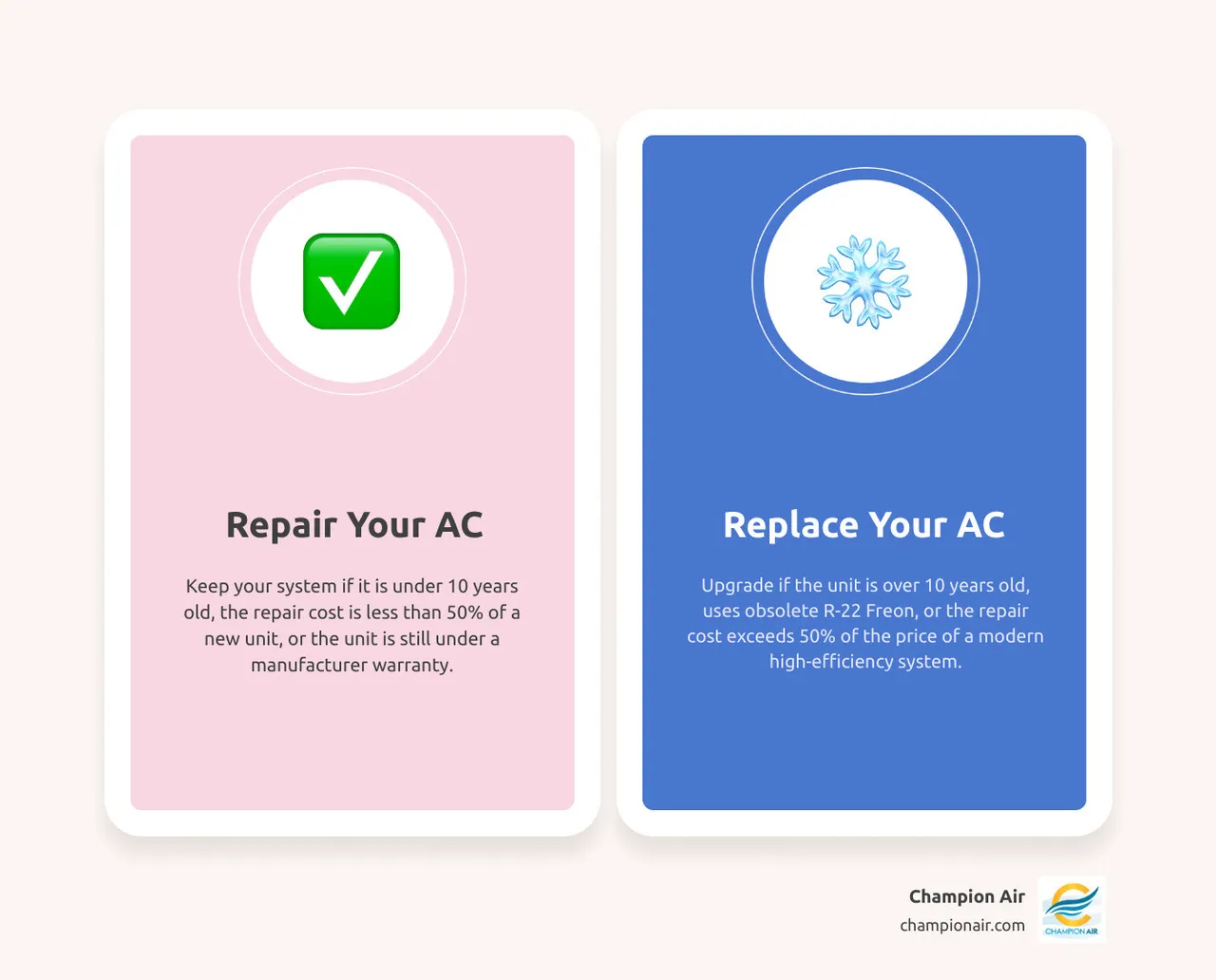
Repair your AC if:
- Your unit is under 10 years old
- The repair cost multiplied by the unit's age is under $5,000
- The repair cost is less than 30-50% of a new system's price
- You have an active manufacturer's warranty
Replace your AC if:
- Your unit is 10 years or older (in Arizona, this threshold is often closer to 8-10 years due to extreme heat and longer runtime)
- The repair cost multiplied by the unit's age exceeds $5,000
- The repair cost is more than 50% of what a new system would cost
- Your system uses R-22 (Freon) refrigerant, which is no longer produced
- You have had two or more significant repairs in the past 12-24 months
If none of those quick rules settle it for you, don't worry. The rest of this guide walks through every factor in plain terms so you can make a confident, informed call.
Most Arizona homeowners don't realize that the standard national advice about AC lifespan simply doesn't apply here. A system in Scottsdale runs roughly 2,000 to 2,700 hours every year — nearly double the national average — which compresses the useful life of your equipment and changes the financial math significantly. What counts as a reasonable repair in Minnesota may be throwing good money after bad in Phoenix.
I'm Barry Farah, and understanding when to repair vs replace your ac system has been at the center of my work leading one of Arizona's largest residential HVAC replacement companies. The framework in this guide reflects what I've seen work for thousands of Arizona homeowners navigating this exact decision.
The Mathematical Framework: When to Repair vs Replace Your AC System

When your air conditioner stops blowing cold air in May 2026, it’s easy to let frustration drive your decision. However, we always recommend taking a step back and looking at the cold, hard numbers. Emotions don't keep your house cool, but a solid financial strategy does. By using established industry rules, you can remove the guesswork and see exactly where your money is best spent.
There are several indicators it is time to replace your HVAC system, ranging from the frequency of your service calls to the general "tiredness" of the machinery. In a high-demand market like ours, understanding AC repair cost in Phoenix helps you weigh those expenses against the long-term value of a new, high-efficiency installation.
Applying the $5,000 Rule to Your AC System
The "$5,000 Rule" is perhaps the most famous calculation in the HVAC world. It’s a simple way to determine if a repair is a "bridge strategy" (a temporary fix) or a "money pit."
To use it, multiply the age of your unit by the estimated cost of the repair. If the total is less than $5,000, go ahead and fix it. If the total is more than $5,000, it’s time to start shopping for a new unit.
For example, if you have a 4-year-old unit and the AC blower motor replacement cost is significant, the math (4 years x the repair cost) will likely stay well under the $5,000 threshold. In this case, repair is the clear winner. However, if that same repair is needed on a 12-year-old unit, you’ll likely soar past that $5,000 mark, signaling that your money is better invested in a down payment for a new system.
The 50% Rule for Major Component Failures
Another vital metric is the 50% Rule. This rule states that if the cost of a single repair exceeds 50% of the value of a brand-new system, you should replace it regardless of the age.
This is especially relevant when dealing with the "heart" of your system. For instance, if you are looking at a high AC compressor replacement cost, you are essentially paying for half a new unit but keeping the old, worn-out coils, fans, and electronics. It’s the equivalent of putting a brand-new engine into a car with 300,000 miles and a rusted frame. It might run for a while, but the other parts are likely right on the edge of failure.
Critical Red Flags: R-22 and the Failure Cascade
Sometimes, the decision isn't just about a single repair bill; it's about the technical reality of your equipment. As we move through 2026, certain older technologies have become "dead ends." If your system is still using R-22 refrigerant (often called Freon), you aren't just dealing with an old machine—you're dealing with an obsolete one.
You might also notice your system entering what we call a "failure cascade." This is when parts begin failing in sequence. You fix a capacitor, then a week later you're asking why your AC is making a buzzing noise, only to find out the contactor has burned out. This is a sign that the system's components have reached their collective "end of life."
Why R-22 Refrigerant is a Major Signal to Replace
If you’ve asked why your AC is not cooling and the technician tells you that you have a refrigerant leak in an R-22 system, the debate over when to repair vs replace your ac system effectively ends.
The EPA phased out the production and import of R-22 in 2020. By 2026, the remaining stockpiles are incredibly scarce and expensive. Recharging an old R-22 unit can cost a small fortune, and it doesn't even fix the leak—it just buys you a little time before the expensive gas leaks out again. Because these units are at least 16 years old (no R-22 units were sold after 2010), they are well past their prime and are no longer financially viable to maintain.
Identifying a Failure Cascade in Aging Units
A failure cascade happens because HVAC components age together. They have endured the same Phoenix dust storms and the same Scottsdale heat waves. When one major part fails, it often puts extra stress on the remaining parts, leading to a chain reaction of breakdowns.
If you’ve noticed 5 signs you need service more than twice in a single summer, your system is likely in a cascade. Frequent repairs are a red flag that the system’s internal integrity is gone. At this point, continuing to repair is simply paying for a very expensive, very slow replacement, one part at a time, without ever getting the benefits of a new warranty or higher energy efficiency.
Impact of the Arizona Climate on System Lifespan
Geography is the most overlooked factor in the when to repair vs replace your ac system conversation. If you look at a national website, they might tell you an AC unit lasts 15 to 20 years. In the Phoenix Valley, that is simply not the reality.
Our climate is a "triple threat" to HVAC equipment: extreme heat, high dust, and intense UV radiation. When it's 115°F in Mesa or Surprise, your AC doesn't just work; it fights for its life. This constant high-load operation leads to "lifespan compression," where a 10-year-old Arizona unit has the "mileage" of a 20-year-old unit in a cooler state. Understanding how long air conditioners last in Arizona is crucial for setting realistic expectations for your home.
Deciding When to Repair vs Replace Your AC System in the Desert
In the desert, we have to account for thermal stress. The metal in your outdoor unit expands and contracts significantly between the 110°F days and 80°F nights. Over a decade, this causes "pinhole" leaks in copper coils and weakens electrical connections.
Furthermore, our monsoon season brings heavy dust that acts like sandpaper on moving parts. If you don't schedule maintenance often, this wear accelerates. By the time a system hits the 10-year mark in Phoenix, it has likely run for over 25,000 hours. For comparison, that’s the equivalent of a car driving over 1.5 million miles. At that point, a major repair is rarely a sound investment.
[TABLE] Arizona AC Lifespan vs. National Average
| Factor | National Average | Arizona (Phoenix Valley) |
|---|---|---|
| Typical Lifespan | 15–20 Years | 8–12 Years |
| Annual Runtime | 1,000–1,500 Hours | 2,000–2,700 Hours |
| Primary Stressor | Humidity/Age | Extreme Heat/Dust/UV |
| Repair Viability @ 10 Years | High | Low to Moderate |
| Efficiency Loss per Year | 1–2% | 2–5% (if unmaintained) |
Financial Incentives and Modern Efficiency Benefits
One of the best reasons to choose replacement over repair in 2026 is the sheer leap in technology. If you are replacing a unit from 2012, you aren't just getting a newer version of what you have; you’re moving from "analog" to "digital."
Modern systems are designed around SEER2 (Seasonal Energy Efficiency Ratio 2) standards. These units are significantly better at squeezing every bit of cooling out of every watt of electricity. When you look at how new HVAC systems save you money, you'll find that the monthly utility savings can actually help offset the cost of the new unit over time.
Upgrading to SEER2 for Long-Term Savings
As of 2023, the Department of Energy raised the bar for efficiency. Today’s SEER2-rated units use variable-speed motors that don't just blast "on" or "off." Instead, they ramp up and down like a dimmer switch, using only the exact amount of energy needed to maintain your comfort.
When determining what size AC unit you need, a professional assessment can often find that a modern, properly sized unit will outperform your old, oversized "clunker" while using 30% to 40% less power. Plus, with the Inflation Reduction Act of 2022 still offering federal tax credits for high-efficiency heat pumps and air conditioners, the "upfront" cost of replacement is lower than it has been in decades.
[LIST] of Modern Comfort Features
- Zoning Technology: No more freezing in the kitchen while the master bedroom stays warm. Zoning allows you to cool only the rooms you are using.
- Enhanced Humidity Control: Even in the desert, humidity can build up inside from cooking and showering. Modern units are master dehumidifiers.
- Whisper-Quiet Operation: Newer compressors and fan blades are designed to be so quiet you’ll barely know they’re running.
- Advanced Air Filtration: Modern systems can be equipped with HEPA-grade filters and UV lights to scrub dust, pollen, and viruses from your indoor air.
- Smart Integration: Control your home's climate from your phone in Scottsdale while you're away on vacation, or let AI-driven diagnostics alert us to a problem before it causes a breakdown.
Frequently Asked Questions about When to Repair vs Replace Your AC System
Deciding when to repair vs replace your ac system often brings up a few common "what-ifs." Whether you're in Peoria, Gilbert, or Cave Creek, these are the questions we hear most often when a system starts to struggle. Dealing with common issues through troubleshooting is a great first step, but for the big decisions, here is what you need to know.
Should I replace my furnace at the same time as my AC?
In most cases, yes. Your AC and your furnace (or air handler) share the same blower motor and ductwork. They are designed to be a "matched system." If you put a brand-new, high-efficiency outdoor AC unit on an old, inefficient indoor furnace, the outdoor unit won't be able to reach its rated SEER2 efficiency. It’s like putting a high-performance racing transmission into an old farm tractor—the two parts just won't speak the same language.
Furthermore, replacing them together saves you money on labor and ensures your entire home comfort system is under a fresh warranty. You can see more about the total picture in our guide on AC replacement cost.
Is my system still under warranty?
This is a huge factor in the repair vs. replace math. Most major manufacturers offer a 5-to-10-year parts warranty. If your unit is 7 years old and the AC fan is not spinning, the part might be free, leaving you only with the labor cost. This makes repair much more attractive. However, keep in mind that warranties usually only cover the parts, not the labor or the refrigerant, which can still be quite expensive. Always have your model and serial number ready so we can check your warranty status for you.
What are the safety risks of keeping an old unit?
An aging HVAC system isn't just inefficient; it can become a safety hazard. Electrical components can become brittle and crack, leading to shorts or even fire risks. If you hear a hissing noise from your AC, it could be a high-pressure refrigerant leak or an internal valve failure. In systems with gas furnaces, an old heat exchanger can crack, potentially leaking carbon monoxide into your home. Replacing an old unit isn't just about comfort—it's about peace of mind for your family's safety.
Conclusion
Deciding when to repair vs replace your ac system is a significant choice, but you don't have to make it alone. At Champion Air, we've spent decades helping our neighbors in Scottsdale, Phoenix, Mesa, and across the Valley find the perfect balance between upfront cost and long-term reliability.
Whether you need a 24/7 emergency repair to get through a record-breaking heat wave or a comprehensive assessment for a new, energy-efficient installation, our licensed and experienced technicians are here to provide honest, expert advice. We specialize in all major brands and offer same-day service to ensure your home remains a sanctuary from the Arizona sun.
Don't wait for a total system failure in the middle of July. Schedule your professional AC replacement or repair assessment today and let us help you keep your cool all year long.
About the Author
Champion Air
More Articles
View All Posts
Ready to Get Started?
Whether you need a repair, maintenance, or a new installation, our expert team is here to help.