The Cold Truth: Why Your AC Is Blowing Warm Air
Champion Air
Discover why is my ac running but not cooling: dirty filters, frozen coils, leaks & more. Phoenix AC repair tips from Champion Air experts.
The Cold Truth: Why Your AC Is Blowing Warm Air
Why Your AC Running But Not Cooling Is a Red Flag You Shouldn't Ignore
Why is my ac running but not cooling is one of the most common — and most stressful — problems Arizona homeowners face, especially when outdoor temperatures are pushing past 110°F and your house just won't cool down.
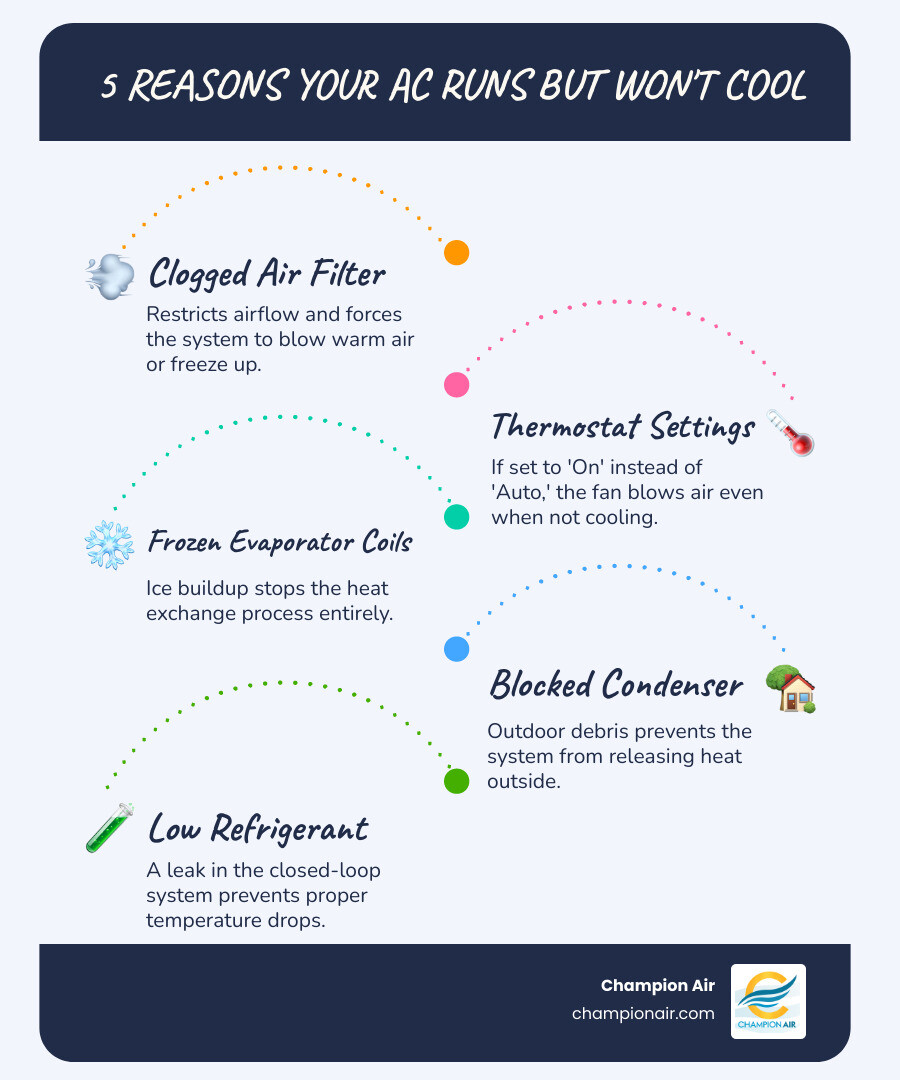
Here are the most common reasons your AC is running but not cooling:
- Dirty or clogged air filter — restricts airflow and can cause the system to blow warm air
- Thermostat set incorrectly — fan set to "On" instead of "Auto," or mode set to "Heat" or "Fan Only"
- Frozen evaporator coils — ice buildup acts as insulation and stops heat transfer entirely
- Low refrigerant (leak) — refrigerant is a closed loop; if it's low, there's a leak
- Failing capacitor — allows the indoor fan to run but prevents the compressor from starting
- Blocked or dirty outdoor condenser unit — can't release heat if it's clogged with debris
- Tripped circuit breaker — the outdoor unit loses power while the indoor fan keeps running
- Leaky ductwork — up to 20–30% of cooled air can escape before reaching your living spaces
- Undersized or aging AC system — struggles to keep up during Arizona's peak summer heat
Most of these issues have a clear fix — some you can handle yourself in minutes, others need a licensed technician. This guide walks you through all of them.
There's a particular kind of frustration that comes with an AC that sounds like it's working — you can hear it humming, air is moving through the vents — but an hour later, the house is still stuffy and hot. In Arizona's extreme summer climate, that's not just uncomfortable. It can be a genuine health risk.
The good news is that most AC cooling failures come down to a handful of well-understood causes. Knowing which one you're dealing with is half the battle.
I'm Barry Farah, and as the leader of one of Arizona's top residential HVAC companies and a longtime Lennox Partner of the Year, I've seen every version of why is my ac running but not cooling — from a simple dirty filter to a failed compressor on a 15-year-old unit. In this guide, I'll walk you through exactly how to diagnose and fix the problem, so you can stop sweating and start cooling.
Troubleshooting the Basics: Why Is My AC Running But Not Cooling?
When your home starts feeling more like a sauna than a sanctuary, your first instinct might be to panic. However, many cooling issues stem from simple settings or maintenance oversights. Before you assume the worst, we recommend a "triage" approach to your HVAC system.
Start by checking your thermostat. It sounds obvious, but it is incredibly common for a thermostat to be accidentally bumped into "Heat" mode or "Fan Only" mode during cleaning or by a curious child. Furthermore, check your fan settings. If the fan is set to "On," the blower will run 24/7, even when the cooling cycle is off. This means it will blow unconditioned, room-temperature air through your vents, making it feel like the system is failing. Always keep your fan set to "Auto."
You should also verify your thermostat's calibration. If the thermostat is located in a drafty hallway or near a sunny window in your Scottsdale home, it might be getting "tricked" into thinking the house is cooler or warmer than it actually is. For more help, you can learn how to troubleshoot your HVAC system for optimal performance to see if a simple reset is all you need.
Why is my AC running but not cooling due to a dirty filter?
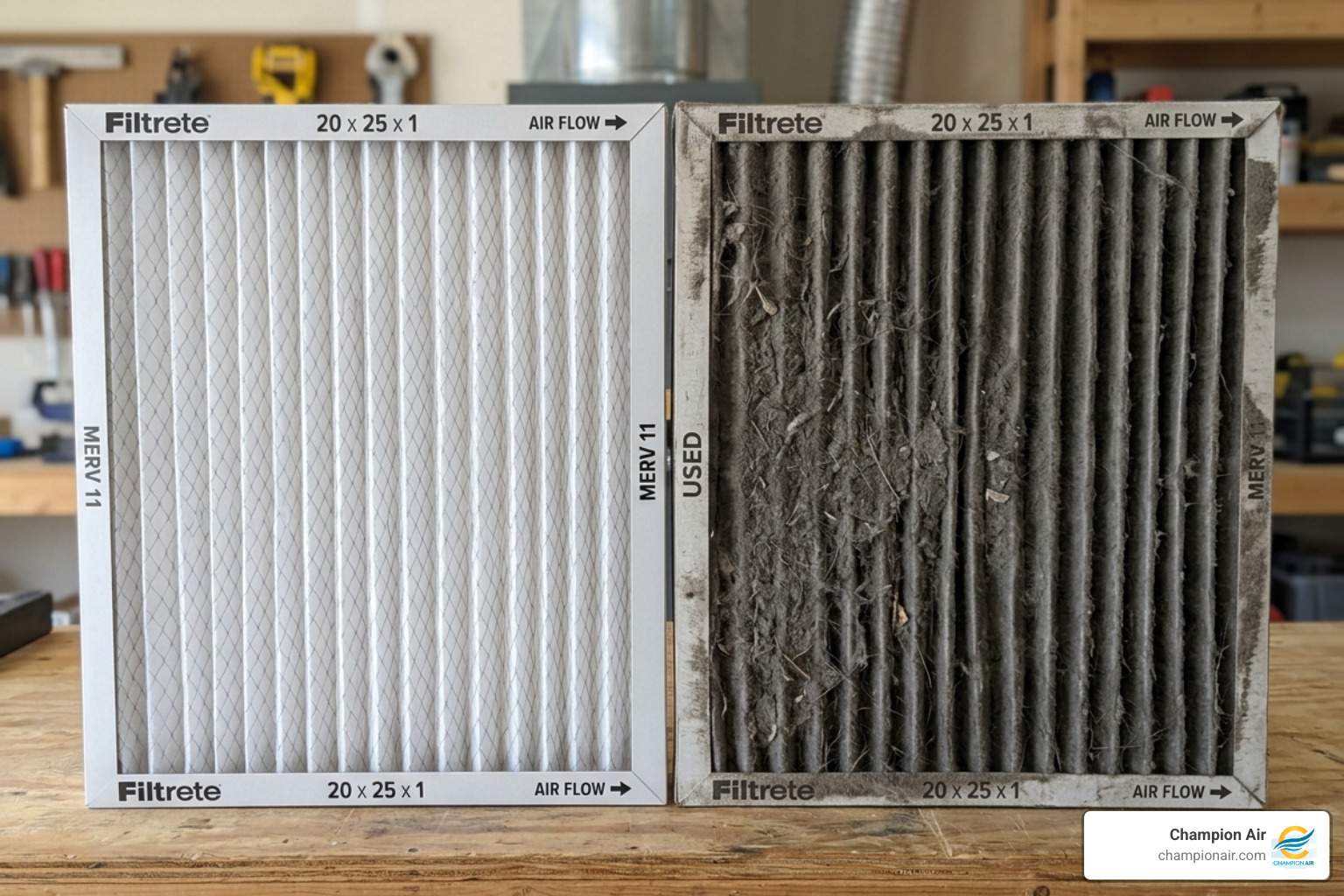
In the Phoenix Valley, dust is our constant companion. When your air filter hasn't been changed in 30 to 90 days, it can accumulate a layer of debris that looks like a "gray felt blanket." This creates severe airflow restriction.
When air can't move through the filter, it stagnates and actually heats up within the system. More importantly, your AC needs a specific amount of airflow to keep the indoor evaporator coils from getting too cold. Without that airflow, the coils freeze over, blocking any remaining cool air from entering your home. If you notice weak airflow or warm air, the filter is the first place to look. If the screen is blank or the system isn't responding, you might be dealing with thermostat issues like dead batteries or a blown fuse.
Checking the outdoor condenser unit for blockages
Your outdoor unit has one primary job: releasing the heat it gathered from inside your home. In locations like Mesa and Gilbert, landscaping can grow quickly, or desert monsoon winds can blow debris against the unit.
For your AC to breathe, it needs at least a 2-foot clearance on all sides. Grass clippings, fallen leaves, and "cottonwood fuzz" can clog the delicate metal fins of the condenser. When these coils are dirty, the heat has nowhere to go, and your AC will run constantly without ever dropping the temperature. We recommend gently rinsing the outdoor unit with a garden hose (never a pressure washer!) to keep it clean. Regular maintenance services are the best way to ensure these coils stay clear year-round.
Common Mechanical Failures in the Phoenix Valley
If the basics check out, we move into mechanical territory. Arizona's extreme heat puts immense strain on components that might last much longer in milder climates. When a mechanical part fails, the system might still "run" (meaning the fans are spinning), but the actual cooling process has stopped.
Why is my AC running but not cooling because of frozen coils?
It seems counterintuitive to have ice on your AC when it's 110°F in Phoenix, but frozen evaporator coils are a common sight. This usually happens due to restricted airflow (that dirty filter we mentioned) or low refrigerant.
When the coils freeze, the ice acts as an insulator. Instead of the refrigerant absorbing heat from your home's air, the ice blocks the heat exchange entirely. If you see frost on the copper lines leading into your house or notice water drips from your air conditioner, you must turn the system off immediately. Running an AC with frozen coils can cause "slugging," where liquid refrigerant returns to the compressor and destroys it. Switch the thermostat to "Off" and the fan to "On" to begin the thawing process, which can take several hours.
The role of a failing capacitor in Arizona heat
The capacitor is like a large battery that provides the high-voltage "kick" needed to start the compressor and the outdoor fan motor. In Arizona, capacitors degrade faster because they are sensitive to extreme heat.
A common symptom of a failed capacitor is hearing a "humming" or "clicking" sound from the outdoor unit, but the fan isn't spinning, or the compressor isn't engaging. Because the indoor blower is still running, it feels like the AC is "on," but no cooling is happening. While capacitors are relatively small parts, they are under high voltage and should be handled by a professional to avoid injury. If you notice your AC fan is not spinning, a bad capacitor is the likely culprit.
Refrigerant Leaks and System Sizing for Arizona Summers
Refrigerant is the lifeblood of your AC. A common misconception is that refrigerant is like gas in a car and gets "used up." In reality, your AC is a closed-loop system. If the refrigerant is low, it means you have a leak.
| Symptom | Refrigerant Leak | Airflow Issue |
|---|---|---|
| Air Temperature | Lukewarm or warm | Weak but cold (until frozen) |
| Noises | Hissing or bubbling | Whistling or loud humming |
| Ice Presence | Often on outdoor copper lines | Usually on indoor evaporator coil |
| Energy Bills | Gradual increase | Sudden spike |
Identifying refrigerant leaks and hissing sounds
If you hear a hissing or bubbling noise near your indoor or outdoor unit, you likely have a significant refrigerant leak. As the "charge" drops, the system loses its ability to remove heat and humidity.
Because handling refrigerant requires EPA Section 608 certification, this is not a DIY fix. Simply "topping off" the Freon without fixing the leak is a temporary and expensive band-aid. We focus on finding the source of the leak and sealing it to protect your compressor from permanent damage. You can check for other signs your air conditioner is low in Freon to confirm your suspicions.
When your AC is undersized for the Scottsdale summer
Sometimes, the system isn't broken—it's just overwhelmed. Every AC has a "design temperature," usually between 92°F and 95°F. When Phoenix hits 115°F, an undersized or aging unit (10–15 years old) simply cannot keep up.
If your AC was installed without a proper Manual J load calculation, it might work fine in May but fail to cool below 80°F in July. As systems age, they lose efficiency, and the "gap" between what the unit can provide and what the house needs grows wider. If your system runs 24/7 and the indoor temperature continues to rise, it may be time to evaluate its size and efficiency.
Electrical Problems and Ductwork Efficiency in Scottsdale Homes
Electrical and structural issues are often the "invisible" reasons why is my ac running but not cooling. These problems occur behind walls or in the attic, away from the homeowner's immediate view.
Ductwork leaks and conditioned air loss
According to the Department of Energy, the typical home loses 20% to 30% of its conditioned air through leaks and poor connections in the ductwork. In Arizona, where attic temperatures can reach 140°F, this is a disaster for your comfort.
If a duct becomes disconnected or develops a large hole, your AC is essentially trying to cool your attic instead of your living room. You might feel air coming out of the vents, but it won't be enough to lower the room temperature. Sealing these gaps with mastic sealant or metal tape can drastically improve cooling performance and lower your energy bills.
Tripped breakers and power surges
Your AC system actually runs on two different electrical circuits: one for the indoor air handler and one for the outdoor condenser. It is possible for the outdoor breaker to trip while the indoor unit stays powered on.
In this scenario, the indoor fan will blow air, but because the outdoor unit (and the compressor) is off, that air won't be cold. If you find a tripped breaker in your garage or main panel, you can try resetting it once. However, if it trips again immediately, do not force it. This is a safety feature indicating an electrical short or a failing component that needs professional attention. Always wait at least 3 minutes before restarting your system to allow pressures to equalize—this is known as the "3-minute rule" and it protects your compressor from mechanical strain. If you see signs you need HVAC service, such as frequent tripping, call us immediately.
Frequently Asked Questions
Should I turn off my AC if it isn't cooling?
Yes. If your AC is running but the air is warm, the system is under immense strain. Continuing to run it can lead to a major component failure, such as a burned-out compressor motor. Turning it off also allows any ice on the coils to thaw, which is a necessary first step for any technician to perform a proper diagnosis.
How do I reset my central air conditioning unit?
To safely reset your unit, turn the thermostat to "Off." Go to your circuit breaker panel and flip the switches for both the indoor and outdoor units to "Off." Wait at least 5 to 10 minutes. Flip the breakers back to "On," then return to your thermostat and set it to "Cool." This allows the control board to reset and the refrigerant pressures to equalize.
Why is my AC blowing air but the house won't cool below 80 degrees?
This is often due to the "design temperature" of the unit or poor home insulation. If it is 115°F outside, a standard AC is designed to maintain a 20-degree difference. If your home has leaky ducts, thin insulation, or an undersized unit, it will struggle to reach your desired setpoint during peak afternoon heat.
I Need Expert AC Repair in Mesa: Who Should I Call?
When DIY checks aren't enough, you need a team that understands the unique demands of the Arizona climate. At Champion Air, we've spent years serving homeowners in Scottsdale, Phoenix, Mesa, and surrounding cities like Surprise and Chandler. We don't just "guess" at the problem; we use a rigorous diagnostic process to get your home back to the comfort zone.
Our professional diagnostic steps include:
- Testing refrigerant charge and checking for leaks with electronic detectors.
- Measuring "Delta T" (the temperature difference between supply and return air).
- Inspecting capacitors and contactors for heat damage.
- Evaluating ductwork integrity and airflow volume.
- Checking the condensate drain line for clogs that could trigger a safety shutoff.
Whether you need a quick capacitor replacement or a comprehensive AC repair service in Phoenix, we are here 24/7 to help. Don't spend another night in a hot house. Explore our full range of air conditioning solutions and let us bring the cold back to your home.
About the Author
Champion Air
More Articles
View All PostsKeep Reading
Related Articles


Ready to Get Started?
Whether you need a repair, maintenance, or a new installation, our expert team is here to help.