Math vs. Melt: Calculating the Cost of Repairing an Old AC
Champion Air
Calculate the 5000 dollar rule for ac replacement in Phoenix heat. Learn repair vs. replace math, save on energy bills with expert tips!
Math vs. Melt: Calculating the Cost of Repairing an Old AC
When Your AC Breaks Down in Arizona, the Math Has to Make Sense
The 5000 dollar rule for ac replacement is a simple formula that helps homeowners decide whether to repair their current system or invest in a new one — and in Arizona's punishing heat, getting that decision right really matters.
Here's the quick answer:
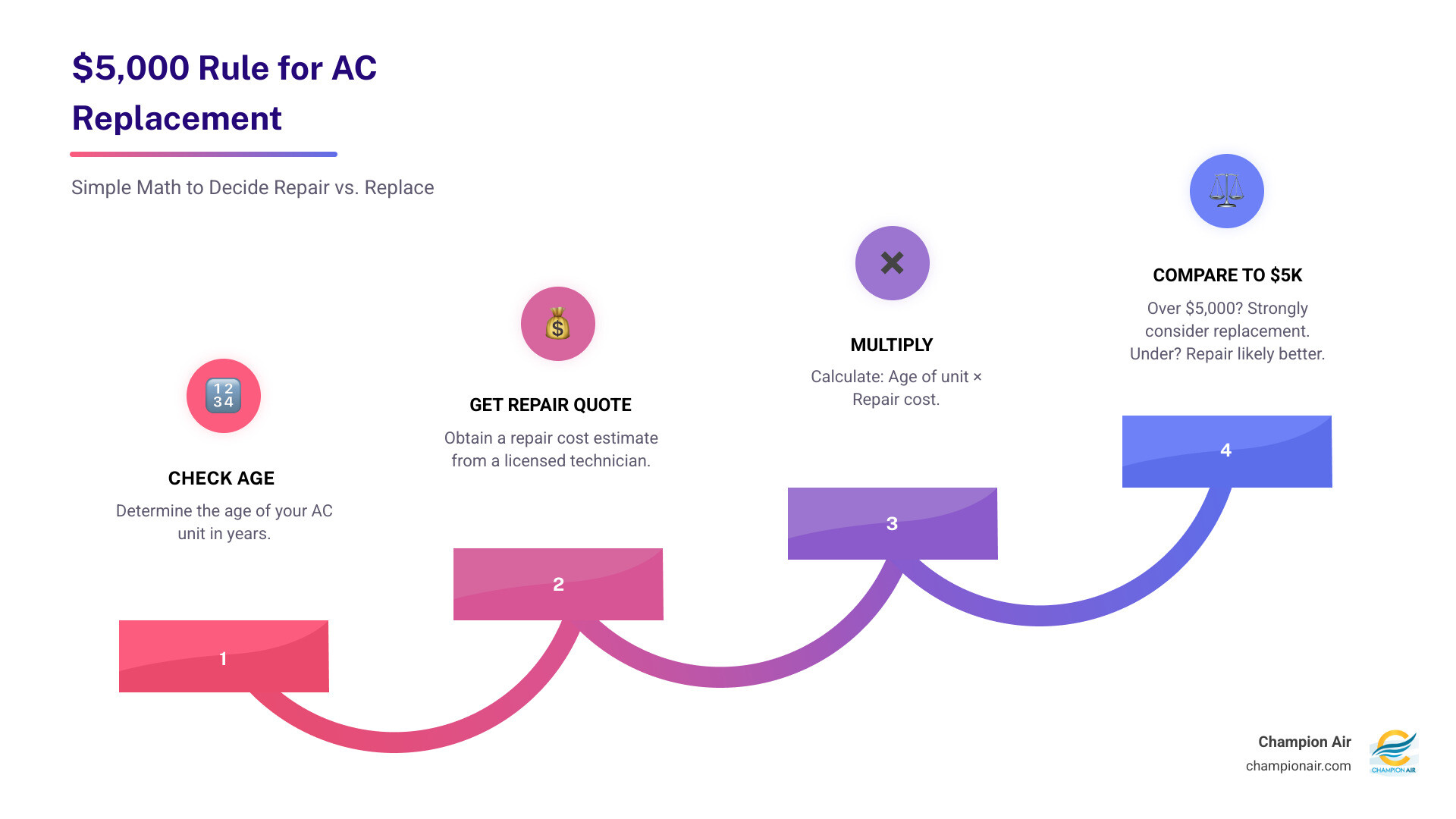
How the $5,000 Rule Works:
| Step | What to Do |
|---|---|
| 1 | Find out how old your AC unit is (in years) |
| 2 | Get a repair estimate from a licensed technician |
| 3 | Multiply: Age of unit × Cost of repair |
| 4 | If the result is over $5,000 → consider replacement |
| 4 | If the result is under $5,000 → repair is likely the better call |
Quick Examples:
- 10-year-old unit + $600 repair = $6,000 → lean toward replacement
- 6-year-old unit + $300 repair = $1,800 → repair makes sense
- 12-year-old unit + $400 repair = $4,800 → borderline, other factors apply
When your AC goes down in the middle of a Phoenix summer, the pressure to make a fast decision is real. The last thing you want is to spend hundreds of dollars on a repair — only to face another breakdown two months later. That's exactly the trap the $5,000 rule is designed to help you avoid.
The rule won't make the decision for you. But it gives you an honest starting point — one based on math, not panic.
I'm Barry Farah, and as the leader of Arizona's largest Lennox family-owned residential replacement company, I've helped thousands of homeowners apply the 5000 dollar rule for ac replacement to make smarter, more confident decisions about their cooling systems. In this guide, I'll walk you through exactly how to use it — and when to look beyond the formula.
Understanding the 5000 dollar rule for ac replacement

When an air conditioner fails, it often happens during the hottest week of the year in places like Scottsdale or Peoria. In that moment of discomfort, it is easy to make a reactive decision. You might think, "Just fix it so I can sleep," or conversely, "I'm done with this old thing, let’s get a new one."
Neither of these emotional responses considers the long-term investment value of your home. That is why we use the 5000 dollar rule for ac replacement. It is a mathematical framework designed to provide an objective assessment of your system's current value versus the cost of keeping it alive. By using a formula, we remove the stress of the unknown and replace it with data.
As we discuss in our guide on Indicators It Is Time to Replace Your HVAC System, sinking money into a system that has already reached its "performance sunset" is often just delaying the inevitable. The $5,000 rule helps you draw a line in the sand.
How to calculate the 5000 dollar rule for ac replacement
Calculating the rule is straightforward. You only need two pieces of information: the age of your unit in years and a written repair estimate from a qualified technician.
The formula is: (Age of Unit) x (Cost of Repair) = Decision Factor
If that Decision Factor is higher than 5,000, the industry standard suggests that replacement is the wiser financial move. Let’s look at how this plays out in real-world scenarios across the Valley:
| Unit Age | Repair Estimate | Calculation | Recommendation |
|---|---|---|---|
| 5 Years | $400 | 5 x 400 = 2,000 | Repair: System is young; repair is cost-effective. |
| 10 Years | $600 | 10 x 600 = 6,000 | Replace: Crossing the threshold; efficiency gains await. |
| 12 Years | $350 | 12 x 350 = 4,200 | Borderline: Repair is okay, but keep a replacement fund ready. |
| 15 Years | $500 | 15 x 500 = 7,500 | Replace: System has exceeded its expected Arizona lifespan. |
The 50% threshold for major components
While the multiplication formula is the primary tool, many professionals also use a secondary rule: the 50% threshold. If a single repair cost exceeds 50% of the cost of a brand-new, high-efficiency system, replacement is almost always the better choice.
This is particularly relevant for major components like the compressor or the evaporator coil. When these parts fail on an older system, it is often a sign of systemic depreciation. Replacing a major part on a 12-year-old unit doesn't reset the clock on the rest of the components; your fan motor, capacitors, and electronics are still 12 years old and prone to failure.
Why System Age and the Arizona Climate Change the Math
In many parts of the country, an air conditioner might last 20 years. In the Phoenix metro area, including cities like Gilbert, Chandler, and Surprise, the reality is different. Our systems work harder and longer than almost anywhere else in the world.
When asking How Long Do Air Conditioners Last in Arizona?, the answer is typically between 10 and 15 years. The extreme thermal stress of 115-degree days, combined with the abrasive dust of monsoon season, accelerates the wear on every moving part. This environmental reality makes the 5000 dollar rule for ac replacement even more critical for local homeowners.
The 10-year performance plummet
Performance often begins to plummet after the 10-year mark. This isn't just about parts breaking; it’s about obsolete technology. Older systems likely use R-22 refrigerant, which has been phased out in the United States. If your system has an R-22 leak, the cost to recharge the refrigerant alone can trigger the $5,000 rule.
Furthermore, older units miss out on modern SEER2 efficiency standards. A system from 2014 might be 20% to 40% less efficient than a new model installed in 2026. This means that even if you repair the old unit, you are still paying a "hidden tax" every month in the form of higher utility bills.
Reliability in extreme temperatures
In Scottsdale or Paradise Valley, a broken AC isn't just an inconvenience; it can be a safety issue. The frequency of repairs tends to increase as a system ages. If you find yourself calling for service every summer, those "minor" repairs start to add up.
Using the $5,000 rule helps you avoid the risk of an emergency breakdown during a record-breaking heatwave. Choosing replacement before a total catastrophic failure gives you the peace of mind that your home will remain a sanctuary, regardless of the temperature in the Sonoran Desert.
Beyond the Math: Factors That Override the Rule
While the math is a fantastic guide, it isn't the only thing we consider. Sometimes, the formula might suggest a repair is okay, but other factors tell a different story.
When evaluating the AC Repair Cost in Phoenix, we look at the system's entire history. A unit that has required three repairs in the last two years is a "lemon" regardless of what the multiplication says.
When to ignore the 5000 dollar rule for ac replacement
There are specific situations where you should bypass the math and move straight to replacement:
- Safety Hazards: If a technician finds a cracked heat exchanger (in a gas furnace/AC combo) or dangerous electrical issues that pose a fire risk.
- Obsolete Refrigerant: If your system uses R-22 and has a major leak, the cost and environmental impact usually make repair a poor choice.
- Major Component Failure on Old Units: If your compressor dies and the unit is over 12 years old, the "50% rule" usually overrides the "5,000 rule."
Conversely, you might choose to repair even if the math is close to the threshold if you are planning to move within the next six months or if the system is still under an active manufacturer warranty that covers the parts.
Comfort and health considerations
Modern AC systems do more than just cool the air; they manage indoor air quality and humidity. If your home has "hot spots," feels stuffy, or if you notice excessive dust accumulation, these are signs that your old system is no longer performing its full job.
Newer systems offer advanced filtration and variable-speed technology that provides more consistent temperatures and better allergen removal. For families in Mesa or Tempe who suffer from seasonal allergies or asthma, the health benefits of a new system often outweigh the simple mechanical repair of an old one.
The Financial Benefits of Choosing Replacement in 2026
Choosing to replace your system isn't just about avoiding repairs; it’s a strategic financial move. As of May 2026, the technology available is more efficient than ever. By understanding How New HVAC Systems Save You Money, you can see how the initial investment pays for itself over time.
New units compliant with SEER2 standards use significantly less electricity to produce the same amount of cooling. For a 2,000 sq. ft. home in Phoenix, this can translate to a 20-40% reduction in monthly cooling costs. When you factor in the Air Conditioner Replacement Cost against these monthly savings, the "break-even" point happens much sooner than most homeowners realize.
Incentives and Tax Credits
One of the biggest reasons to choose replacement in 2026 is the availability of federal and local incentives. Under the Energy Efficient Home Improvement Credit, homeowners can receive up to $600 back (or 30% of the project cost) for qualifying high-efficiency central AC systems.
When you combine these federal tax credits with local utility rebates from providers like SRP or APS, the net cost of a new system drops significantly. These incentives are designed to make the transition to high-efficiency cooling more accessible for everyone in the Valley.
Long-term warranty protection
A hidden cost of repairing an old unit is the lack of protection. Most repairs only come with a 30-to-90-day warranty on the specific part replaced. A new system, however, comes with robust manufacturer warranties that often cover major components for 10 years or more.
This protection eliminates the "repair anxiety" that comes with owning an aging unit. You won't have to worry about the cost of a motor or a coil for a decade, allowing you to budget with confidence.
Frequently Asked Questions about AC Replacement
How long do most air conditioners last in the Phoenix valley?
While the national average is 15-20 years, the intense Arizona heat usually limits the lifespan of a well-maintained unit to 10-15 years. If your unit is approaching the 12-year mark, it is time to start using the $5,000 rule for every repair estimate you receive.
Should I get a professional evaluation before using the $5,000 rule?
Absolutely. The rule only works if you have an accurate, professional repair estimate. A "guess" from a neighbor or an online search isn't enough. Our experts provide detailed AC Installation & Replacement in Phoenix evaluations that consider your home's square footage, insulation, and ductwork condition to ensure the math is accurate.
Does the rule apply to heat pumps and furnaces?
Yes. The $5,000 rule is a standard HVAC industry guideline that applies to heat pumps and furnaces as well. However, because furnaces typically last a bit longer (15-20 years) since they run less frequently in Arizona, you might find the math leans toward repair more often for heating components than for cooling ones.
Conclusion
Deciding whether to fix your air conditioner or replace it is one of the most significant maintenance decisions you will make as a homeowner. By using the 5000 dollar rule for ac replacement, you take the guesswork out of the process and ensure your hard-earned money is being spent wisely.
At Champion Air, we pride ourselves on being the trusted experts for Scottsdale, Phoenix, Mesa, and the surrounding areas. Whether you need a 24/7 emergency repair or a comprehensive evaluation for a new system, our licensed technicians are here to provide honest, reliable solutions tailored to the unique demands of the Arizona climate. We serve everyone from Anthem to Apache Junction and Buckeye to Queen Creek with the same commitment to excellence.
Don't let the summer heat force you into a bad financial decision. Schedule your professional AC evaluation today and let us help you find the most cost-effective way to keep your home cool and comfortable.
About the Author
Champion Air
More Articles
View All PostsKeep Reading
Related Articles


Ready to Get Started?
Whether you need a repair, maintenance, or a new installation, our expert team is here to help.