Stop Burning Cash to Stay Cool This Summer
Champion Air
Discover how much does a high seer ac save in the desert. Cut cooling costs up to 38% in Phoenix heat with SEER2 efficiency tips!
Stop Burning Cash to Stay Cool This Summer
Why How Much Does a High SEER AC Save in the Desert Is a Question Every Arizona Homeowner Should Be Asking
How much does a high SEER AC save in the desert is one of the most important questions you can ask before your next AC purchase — and the short answer is: a lot more than it would save almost anywhere else in the country.
Here's a quick look at what the research shows:
| Upgrade Path | Estimated Annual Savings | 15-Year Savings |
|---|---|---|
| 14 SEER → 16 SEER (Phoenix) | ~$115–$400/year | ~$1,725–$6,000 |
| 10 SEER → 16 SEER (desert) | Up to 38% reduction in cooling costs | $6,000+ |
| 9 SEER → 18 SEER2 (desert) | ~52% reduction in annual cooling costs | Significant |
| Every 1-point SEER increase | ~5–7% savings on cooling electricity | Compounds over time |
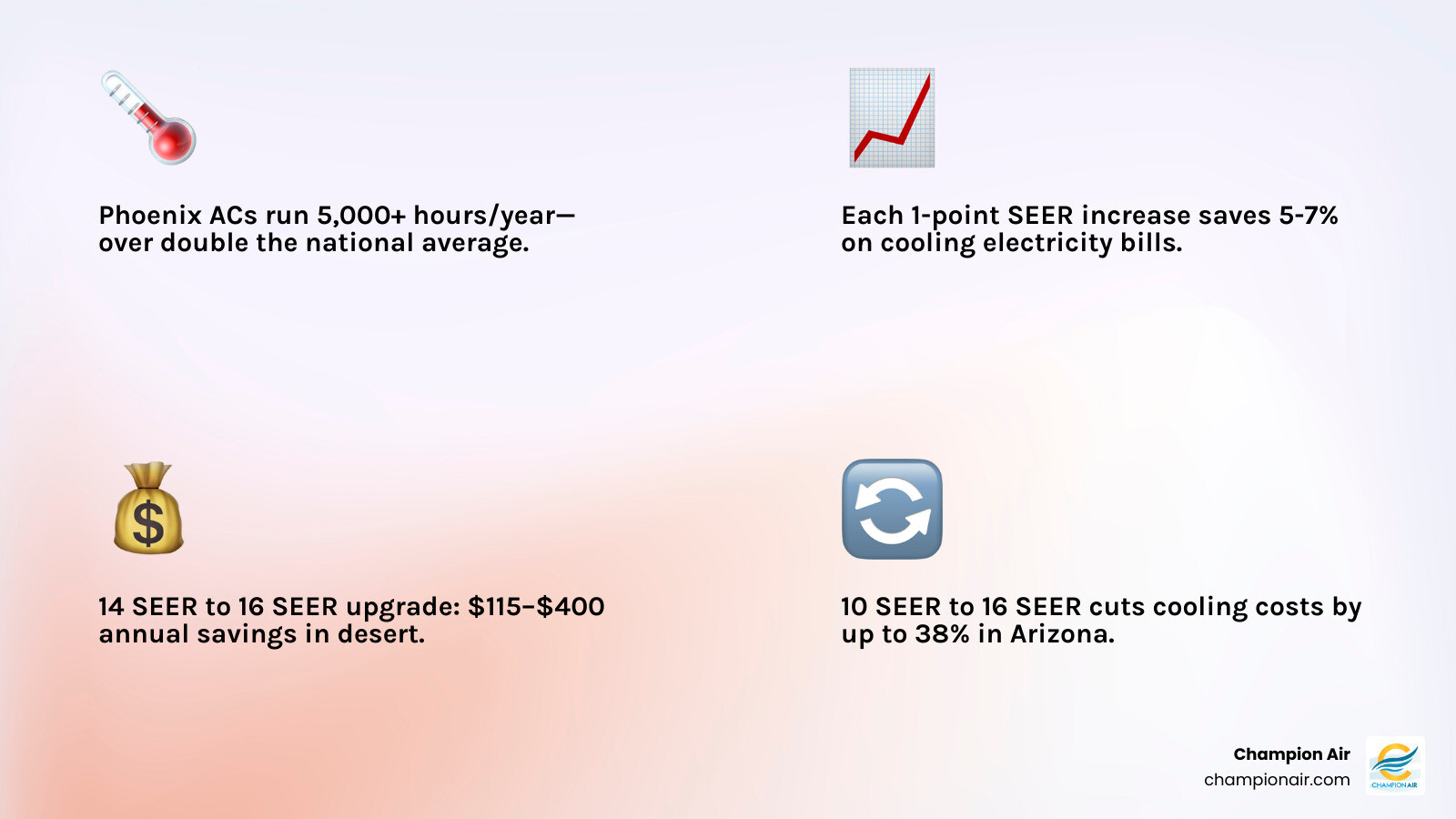
Those numbers aren't a fluke. Phoenix air conditioners run roughly 5,000 or more hours per year — more than double the national average. That means every point of efficiency you gain gets multiplied across an extraordinarily long cooling season. An upgrade that might take 15 years to pay off in Minnesota can pay for itself in under a decade in the Arizona desert.
And yet, most homeowners don't know their current SEER rating. Many are running systems from the 1990s or early 2000s that operate at SEER 8–10 — units that are essentially burning money every time the thermostat kicks on during a 110°F July afternoon.
I'm Barry Farah, and alongside my son I lead one of Arizona's largest Lennox family-owned residential HVAC replacement companies — which means I've spent years helping desert homeowners answer the exact question of how much does a high SEER AC save in the desert, one home at a time. Let's break down the real numbers so you can make a confident, informed decision.
Understanding SEER2 Standards in the Arizona Desert
If you’ve been shopping for a new air conditioner in Scottsdale or Phoenix recently, you might have noticed a new term popping up: SEER2. While it sounds like a movie sequel, it’s actually a major shift in how we measure energy efficiency.
SEER stands for Seasonal Energy Efficiency Ratio. Think of it like the "miles per gallon" for your air conditioner. In the past, SEER was calculated under laboratory conditions that didn't always reflect the reality of a home in Mesa or Peoria. Starting in 2023, the Department of Energy (DOE) mandated a switch to SEER2.
The big difference? SEER2 testing uses a much higher external static pressure. This is a fancy way of saying the test now accounts for the resistance of your home's actual ductwork. Because this test is harder to pass, SEER2 ratings are typically about 4.5% lower than the old SEER numbers for the same piece of equipment.
In the Southwest region (which includes Arizona), the standards are stricter than in the North. As of 2026, the minimum requirement for newly installed central AC systems in our desert climate remains aligned with these updated efficiency mandates. When you're trying to figure out everything you need to know about SEER ratings, a 14.3 SEER2 unit is roughly equivalent to the old 15 SEER standard.
How Much Does a High SEER AC Save in the Desert?
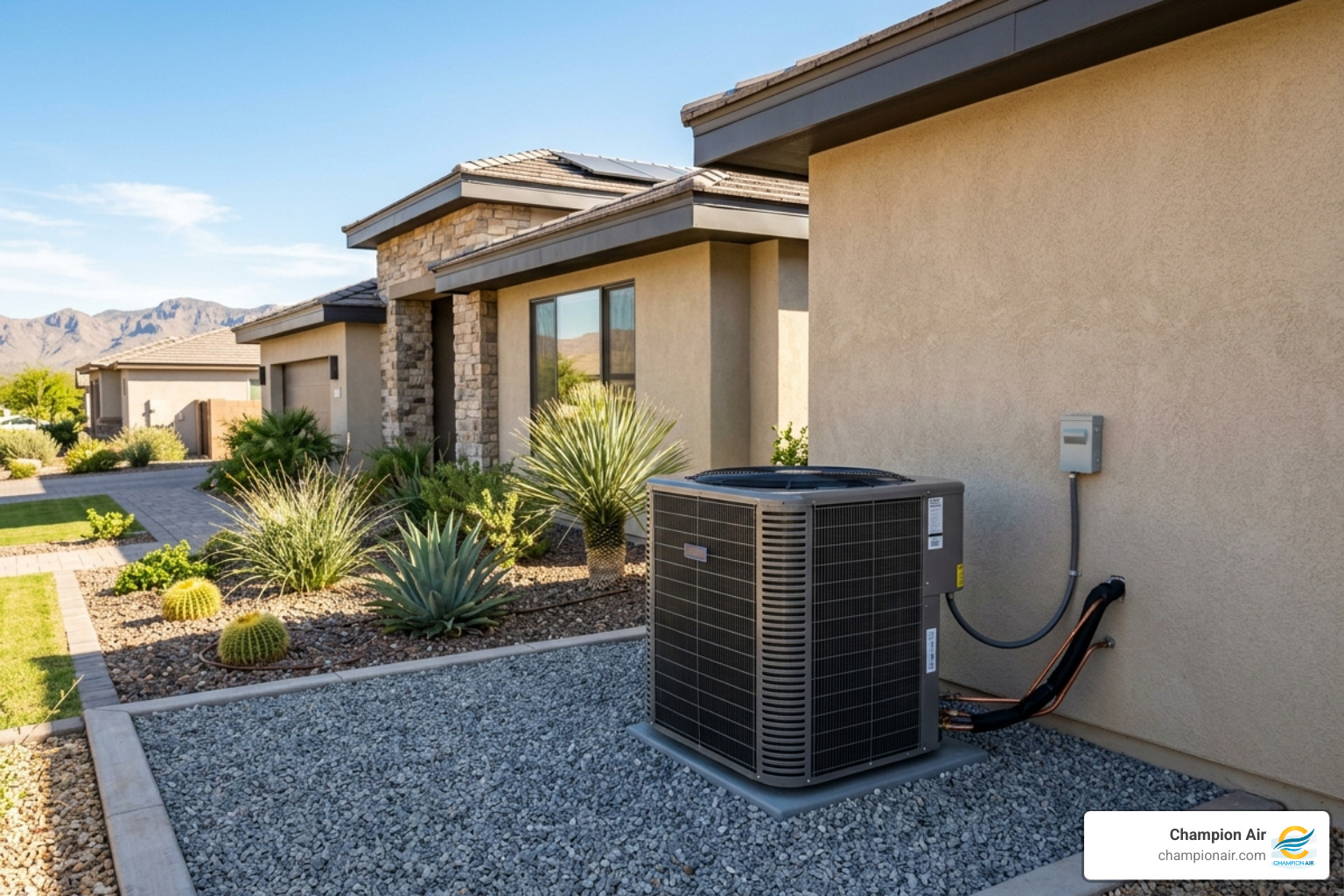
In a place like Phoenix, our air conditioners aren't just a luxury; they are a lifeline. Because we experience over 5,000 cooling hours per year, the efficiency of your unit has a massive impact on your monthly overhead.
When we look at how much does a high SEER AC save in the desert, we have to look at the "efficiency jump." For example, moving from a 14 SEER unit (the previous federal minimum) to a 16 SEER unit represents a roughly 14% increase in efficiency. In a climate where the AC runs for eight months out of the year, that 14% translates to hundreds of dollars in annual savings.
In cities like Surprise, Chandler, and Gilbert, a 16 SEER AC can save a homeowner $400 or more annually compared to older, lower-efficiency models. Over the 15-to-20-year lifespan of a high-efficiency unit, those savings can accumulate to over $6,000.
Calculating the Savings of a High SEER AC in the Desert
To get a real sense of your potential return on investment, you can use a simple rule of thumb: for every one-point increase in a system's SEER rating, you can expect to save approximately 5% to 7% on your annual cooling costs.
If you are currently running an old 10 SEER unit—which was common in the early 2000s—and you upgrade to a 16 SEER system, you are looking at a 38% reduction in cooling costs. If your summer electric bill is currently $400 a month, that’s a savings of over $150 every single month during the peak of summer.
When you understand how new HVAC systems save you money, you start to see that the unit eventually pays for itself. In the Valley of the Sun, the payback period for a high-efficiency upgrade is significantly shorter than in cooler regions because our high runtimes accelerate the "break-even" point.
Maximizing How Much a High SEER AC Saves in the Desert Through Proper Installation
Simply buying a high-SEER unit isn't enough to guarantee those savings. If you put a world-class engine in a car with flat tires, you aren't going to get great gas mileage. The same applies to your HVAC system.
To truly maximize how much does a high SEER AC save in the desert, your home needs to be ready. This includes:
- Duct Sealing: The average home loses 20% to 30% of its conditioned air through leaks in the ductwork. If your ducts are leaking into your 150°F attic, your high-SEER unit has to work twice as hard.
- Attic Insulation: Without proper insulation, the desert heat radiates directly through your ceiling, forcing the AC to run longer cycles.
- Variable-Speed Technology: The benefits of variable inverter air conditioner technology are massive in Arizona. Unlike standard units that are either "all on" or "all off," variable-speed units can ramp down to 25% or 50% capacity. This allows them to maintain a perfect temperature using a fraction of the electricity.
Why EER Matters More During a Phoenix Heatwave
While SEER is the most famous acronym, there is another one you need to know: EER (Energy Efficiency Ratio).
SEER is an average calculated over an entire season based on a constant temperature of 83°F. But let’s be honest—how many days in a Scottsdale summer stay at 83°F? EER, on the other hand, is measured at a steady 95°F.
In extreme desert heat, EER is often a more accurate predictor of peak performance. Some high-SEER units achieve their ratings by performing exceptionally well in "shoulder seasons" (like March or October) but might struggle when the thermometer hits 115°F. To ensure your home stays cool during a record-breaking heatwave, we recommend looking for units with a high EER2 rating in addition to a high SEER2. This ensures the system has the "sensible heat" removal capacity to handle the most brutal days of the year.
| Metric | Test Temperature | Why It Matters in Arizona |
|---|---|---|
| SEER2 | Varies (Avg. 83°F) | Good for overall seasonal budget |
| EER2 | Constant 95°F | Crucial for performance during 110°F+ days |
Comfort Benefits Beyond Energy Savings
When people ask how much does a high SEER AC save in the desert, they usually focus on the checkbook. But there’s a "comfort ROI" that is just as valuable.
High-efficiency units, especially those with two-stage or variable-speed compressors, provide much more consistent temperatures. Have you ever noticed that in an older home, the AC kicks on, freezes you out for ten minutes, and then shuts off until the room feels stuffy again? High-efficiency systems eliminate those "swing" temperatures by running longer, lower-intensity cycles.
This is particularly helpful during the Arizona monsoon season. Even though our desert is dry, the humidity spikes in July and August. Because high-efficiency units run longer cycles at lower speeds, they are significantly better at removing moisture from the air, preventing that "cold and clammy" feeling. When you why choose a Lennox variable system, you're choosing a system designed to handle these exact climate shifts.
Improving Indoor Air Quality with High-Efficiency Systems
High-efficiency systems don't just move air; they clean it. Because these units run more frequently (at lower speeds), the air in your home passes through your filters more often.
During a Phoenix haboob or a dusty Scottsdale afternoon, this constant filtration is vital. High-efficiency blowers are often designed to handle higher-rated MERV filters without straining the motor. This means you can maximize home comfort & efficiency with Lennox products by integrating advanced air purification that captures dust, pollen, and even viruses, keeping your indoor air as fresh as it is cool.
Frequently Asked Questions about Desert AC Efficiency
What is the minimum SEER rating for Arizona in 2026?
As of 2026, the minimum standard for the Southwest region (including Phoenix and surrounding cities) remains at 14.3 SEER2 for split systems. This is higher than the standards for northern states because of our extreme cooling demands.
Does a higher SEER unit cool my house faster?
Not necessarily. A 3-ton unit is a 3-ton unit regardless of its SEER rating. However, a high-SEER unit will cool your house smarter. By using variable speeds, it maintains the temperature more effectively and removes more humidity, which makes the air feel cooler at a higher thermostat setting.
How long does it take for a high-efficiency AC to pay for itself?
In the Arizona desert, the payback period is typically between 7 and 10 years, depending on your usage and utility rates. Given that a well-maintained system should last 15 to 20 years, you could enjoy a decade or more of pure profit in the form of lower energy bills.
Conclusion
At Champion Air, we’ve seen how the right technology can transform an Arizona summer from a financial burden into a season of comfortable, affordable living. Whether you are in Scottsdale, Phoenix, Mesa, or anywhere in the Valley, understanding how much does a high SEER AC save in the desert is the first step toward taking control of your home's energy future.
Upgrading to a high-efficiency system isn't just about the immediate drop in your electric bill—it’s about the long-term reliability and comfort that your family deserves. If you're ready to stop burning cash and start enjoying a cooler home, our team of experts is here to help you find the perfect system for your specific needs.
About the Author
Champion Air
More Articles
View All PostsKeep Reading
Related Articles


Ready to Get Started?
Whether you need a repair, maintenance, or a new installation, our expert team is here to help.