Why Your AC Capacitor Keeps Quitting on You
Champion Air
Why Your AC Capacitor Keeps Quitting on You
Why Capacitor Failure Is the Most Common AC Repair — And What Arizona Homeowners Need to Know
Capacitor failure why it is the most common ac repair is a question worth answering fast: capacitors are small electrical components that take a massive beating every single day, and in Arizona's brutal heat, they wear out faster than almost any other part in your system. Here's a quick breakdown of why:
- High-stress role — The capacitor provides the electrical jolt that starts your compressor and fan motor on every single cycle
- Heat sensitivity — Internal temperatures inside an outdoor AC unit can exceed 150°F, which breaks down the capacitor's internal materials over time
- Constant cycling — Arizona's long cooling season means your capacitor gets used far more often than in milder climates
- Electrical fatigue — Power surges, brownouts, and voltage fluctuations all add wear that shortens a capacitor's life
- Statistics back it up — Capacitor failure accounts for roughly 30% of all AC service calls, making it the single most common AC repair technicians perform
If your AC is humming but not starting, blowing warm air, or clicking off on a 110-degree afternoon, a failing capacitor is the most likely culprit.
I'm Barry Farah, and as the leader of one of Arizona's largest residential HVAC companies, I've seen how capacitor failure why it is the most common ac repair plays out for homeowners across Scottsdale, Phoenix, and Mesa — especially during peak summer heat. In this guide, I'll walk you through exactly why it happens and what you can do about it.
What is an AC Capacitor and How Does It Work?
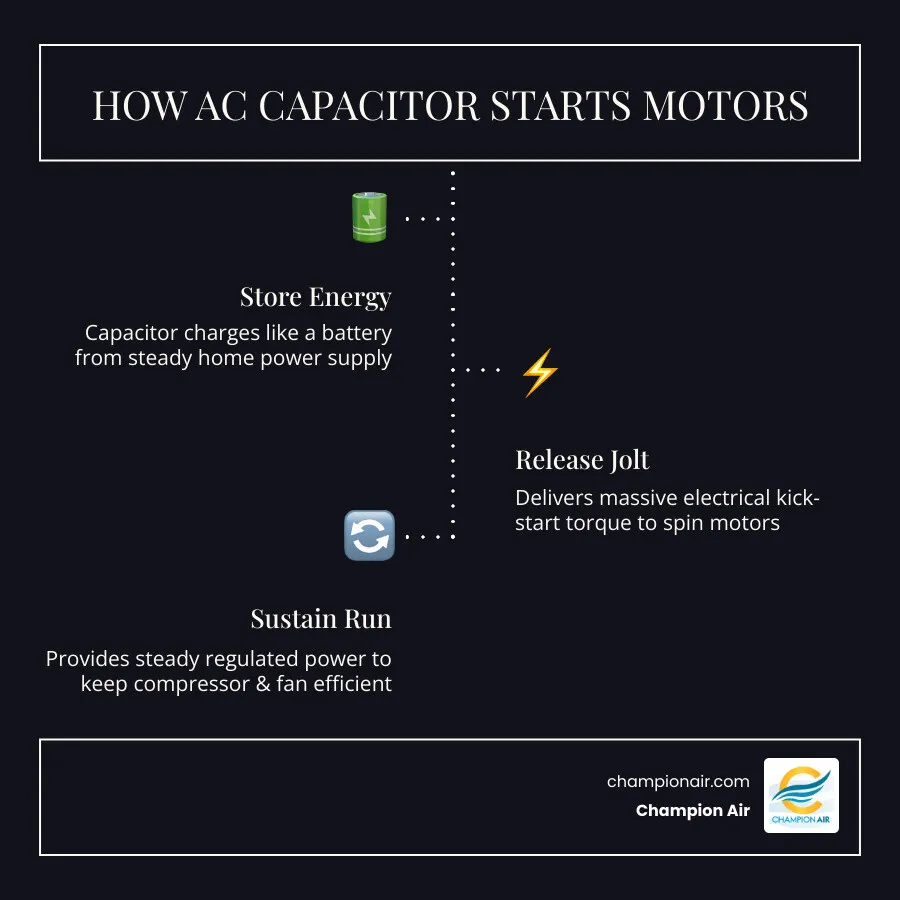
To understand why this part fails so often, we first need to look at what it actually does. Think of an AC capacitor as a tiny, high-powered rechargeable battery that lives inside your outdoor unit. While your home’s electrical system provides a steady flow of power, it doesn’t always provide enough "oomph" to get heavy motors spinning from a dead stop. That is where the capacitor comes in.
It stores up electrical energy and releases it in a massive, split-second jolt. This "kick-start" provides the torque necessary to start the compressor and the outdoor fan motor. Once the motors are running at full speed, the capacitor continues to provide a steady, regulated flow of power to keep them spinning efficiently.
Start vs. Run Capacitors
In HVAC, there are two main types of capacitors you should know about:
- Start Capacitors: These provide the initial burst of energy to get the motor moving. They stay active for only a fraction of a second.
- Run Capacitors: These stay active throughout the entire cooling cycle, helping the motor maintain a constant, smooth rotation.
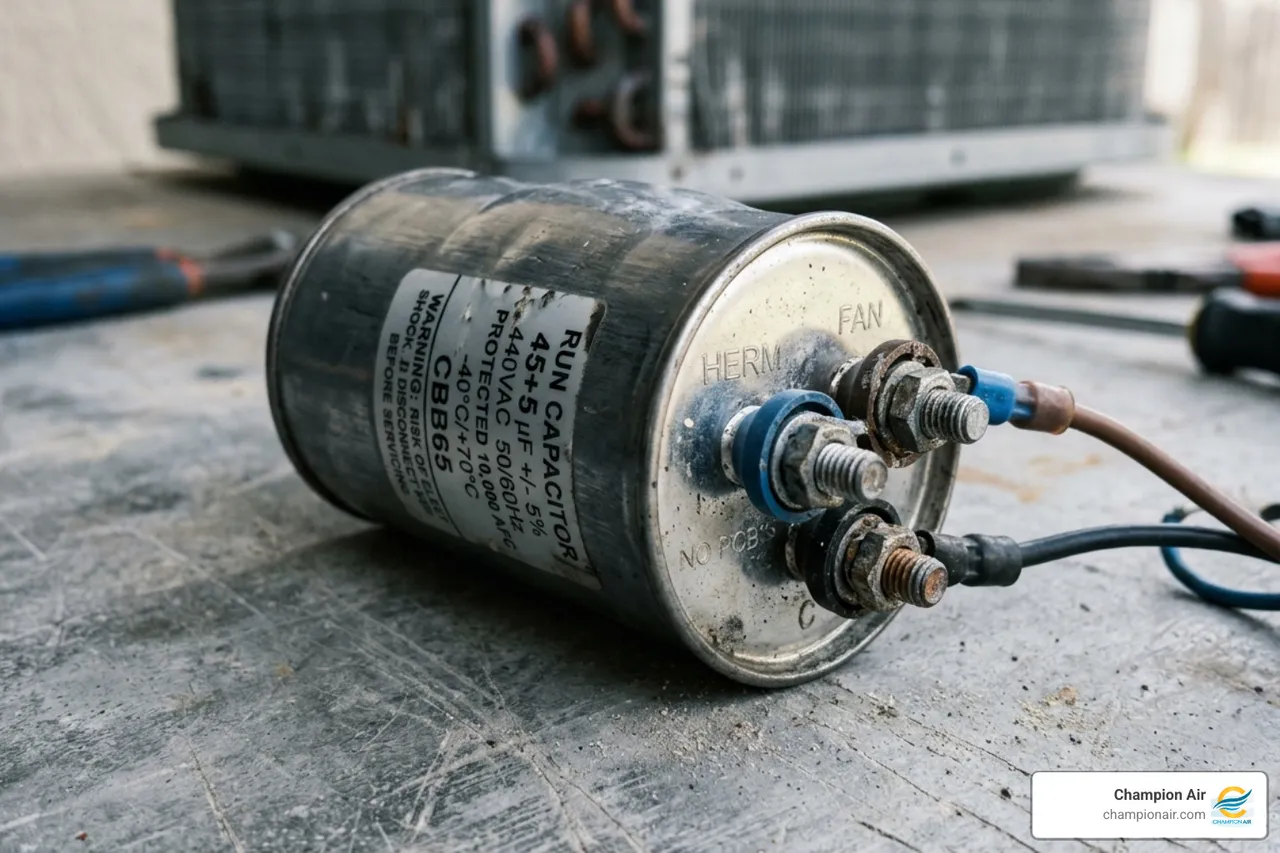
Most modern residential units in Phoenix and Scottsdale use what we call a Dual Run Capacitor. This is a single component that handles the electrical needs of both the compressor and the fan motor simultaneously. It is measured in microfarads (µF) and has a specific voltage rating. If these measurements drift even 10% away from their factory settings, the system starts to struggle. This is often the primary reason why your AC fan is not spinning.
Capacitor failure why it is the most common ac repair
If you’ve lived in the Valley for a few summers, you’ve likely experienced a sudden AC breakdown. When our technicians arrive at a home in Surprise or Gilbert, the first thing they check is almost always the capacitor. Industry data shows that capacitor failure why it is the most common ac repair accounts for approximately 30% of all HVAC service calls.
Why is this the "weakest link" in your cooling chain? Primarily because it is a high-stress component. Unlike a piece of copper tubing or a metal cabinet, a capacitor is an active electronic device filled with sensitive chemicals and conductive plates. Every time your AC clicks on—which can happen dozens of times a day in July—the capacitor undergoes a high-voltage discharge. This creates electrical fatigue, making it a natural wear-and-tear item that simply isn't designed to last forever. When it fails, you'll need a professional AC Repair Service in Phoenix, AZ to get things back to normal.
Why Arizona heat causes capacitor failure why it is the most common ac repair
In a milder climate like the Pacific Northwest, a capacitor might last 15 to 20 years. In Arizona, we consider 5 to 7 years a "good run." The desert environment is uniquely hostile to electrical components for several reasons:
- Extreme Thermal Stress: While it may be 110°F outside, the internal temperature of your outdoor unit’s electrical compartment can soar past 150°F. This intense heat causes the oil and chemicals inside the capacitor to expand and eventually leak or dry out.
- Desert Monsoons: Dust and debris from our summer storms can coat the condenser coils. When the coils are dirty, the motors have to work harder and run longer, which puts a massive secondary load on the capacitor.
- Constant Cycling: Because our cooling season lasts from March through October, capacitors in Phoenix and Mesa perform thousands more "starts" than units in other parts of the country. This leads to your AC not cooling just when you need it most.
Recognizing the signs of capacitor failure why it is the most common ac repair
You don't always have to wait for a total breakdown to know something is wrong. Catching a weak capacitor early can save you from a much more expensive repair. Keep an ear out for these common HVAC issues:
- Clicking or Humming: If you hear a loud "click" followed by a low humming sound from the outdoor unit, but the fan isn't spinning, the capacitor is likely failing to provide the start-up jolt.
- Hard Starting: This is when the AC seems to "stutter" or struggle for several seconds before the compressor finally kicks in.
- Warm Air: If the fan is spinning but the compressor hasn't started, your vents will blow room-temperature air.
- Flickering Lights: A weak capacitor causes the motor to pull more "inrush" current from your home's electrical panel, which can cause your lights to dim briefly when the AC starts.
The Main Causes and Risks of Capacitor Breakdown
Beyond just the heat, several factors contribute to capacitor failure why it is the most common ac repair.
- Power Surges and Spikes: Arizona is known for lightning during monsoon season. A single voltage spike can instantly "pop" a capacitor. Even minor fluctuations in the power grid can cause cumulative damage to the dielectric material inside the part.
- Short Cycling: If your AC is oversized for your home or if your thermostat is malfunctioning, the system may turn on and off too frequently. Since the "start" is the hardest part of the cycle, this rapidly exhausts the capacitor’s lifespan.
- Age and Wear: Like a lightbulb, every capacitor has a finite number of hours it can operate. Once it hits that limit, the internal materials break down, and the unit will mushroom or leak. These are all signs you need HVAC service immediately.
The danger of ignoring a failing capacitor
Many homeowners think, "If it's still running, it's fine." This is a dangerous mindset when it comes to capacitors. A weak capacitor forces the compressor and fan motors to draw significantly more amperage to stay running. This extra electricity turns into heat, which can melt the wire insulation inside your expensive motors.
| Component | Impact of Weak Capacitor | Risk Level | Potential Outcome |
|---|---|---|---|
| Compressor | Increased amperage and heat | Critical | Permanent motor burnout |
| Fan Motor | Struggles to maintain RPM | High | Bearing failure / Motor replacement |
| Electrical Wiring | Overheating due to high draw | Medium | Melted terminals or fire hazard |
| Energy Bill | System runs longer and less efficiently | Guaranteed | Monthly financial loss |
Ignoring a $200 repair can easily turn into a $3,000 compressor replacement. If your unit is struggling, it is far better to address it now than to face a total system failure in the middle of a Phoenix heatwave.
How to Prevent Premature Capacitor Failure in Hot Climates
While you can't stop the Arizona sun from shining, you can take steps to protect your equipment. Prevention is the best way to ensure you aren't part of the 30% of homeowners calling for emergency repairs this summer.
- Schedule Annual Maintenance: This is the single most important step. During a professional AC maintenance visit, a technician will use a multimeter to measure the "strength" of your capacitor. We can often tell if a capacitor is going to fail months before it actually does, allowing for a proactive replacement.
- Keep It Clean: Regularly clear away weeds, desert broom, and debris from around your outdoor unit. Ensure there is at least two feet of clearance to allow for proper airflow.
- Install Surge Protection: A dedicated HVAC surge protector can act as a shield, absorbing voltage spikes from lightning or grid issues before they reach your sensitive capacitors.
- Provide Shade: If possible, provide shade for your outdoor unit—but be careful not to restrict airflow. A shaded unit stays cooler and operates with less internal pressure.
- Change Your Filters: A clogged filter makes the blower motor work harder, which can create a ripple effect of electrical strain throughout the system.
Frequently Asked Questions about AC Capacitors
Can I replace an AC capacitor myself?
We strongly advise against DIY capacitor replacement. While the part itself looks simple, capacitors are designed to store a massive electrical charge—even when the power to the house is turned off. Handling one improperly can result in a severe electrical shock. Furthermore, installing the wrong size or voltage rating can instantly destroy your compressor. To protect your safety and your manufacturer warranty, always call a licensed professional.
How long do AC capacitors typically last in Phoenix?
In the Phoenix Valley, we typically see capacitors last between 5 and 10 years. However, if your unit is in direct sunlight all day or if you have a history of power fluctuations in your neighborhood (common in older parts of Scottsdale or Mesa), that lifespan can drop to 3 or 4 years.
What does a blown capacitor look like?
A healthy capacitor has a perfectly flat top. A failed or "blown" capacitor will often have a "mushroomed" or bulging top. In some cases, you might see an oily liquid leaking from the terminals or even black burn marks. However, keep in mind that many capacitors fail internally without showing any physical signs at all, which is why professional testing is so important.
Conclusion
At Champion Air, we know that there is never a "good" time for your air conditioner to break down. Whether you are in Paradise Valley, Peoria, or Queen Creek, we are dedicated to keeping your home cool and comfortable all year long. Because capacitor failure why it is the most common ac repair is such a frequent issue in our desert climate, our trucks are always stocked with the high-quality parts needed to get your system running again on the very same day.
Don't let a small electrical part turn into a major headache. Our licensed technicians provide 24/7 emergency AC repair services with no overtime charges, ensuring you get the help you need exactly when you need it.
Is your AC humming, clicking, or struggling to start? Schedule your professional AC inspection today and let us ensure your system is ready to handle the Arizona heat!
About the Author
Champion Air
More Articles
View All Posts
Ready to Get Started?
Whether you need a repair, maintenance, or a new installation, our expert team is here to help.