When Your AC Can’t Keep Up: A Troubleshooting Guide
Champion Air
When Your AC Can’t Keep Up: A Troubleshooting Guide
Why Your AC Running But House Still Warm Troubleshooting Matters in Arizona
AC running but house still warm troubleshooting is something thousands of Arizona homeowners face every summer — and the stakes here are higher than almost anywhere else in the country. When temperatures push past 110°F in Phoenix, Scottsdale, and Mesa, a system that runs without actually cooling isn't just uncomfortable. It can be dangerous.
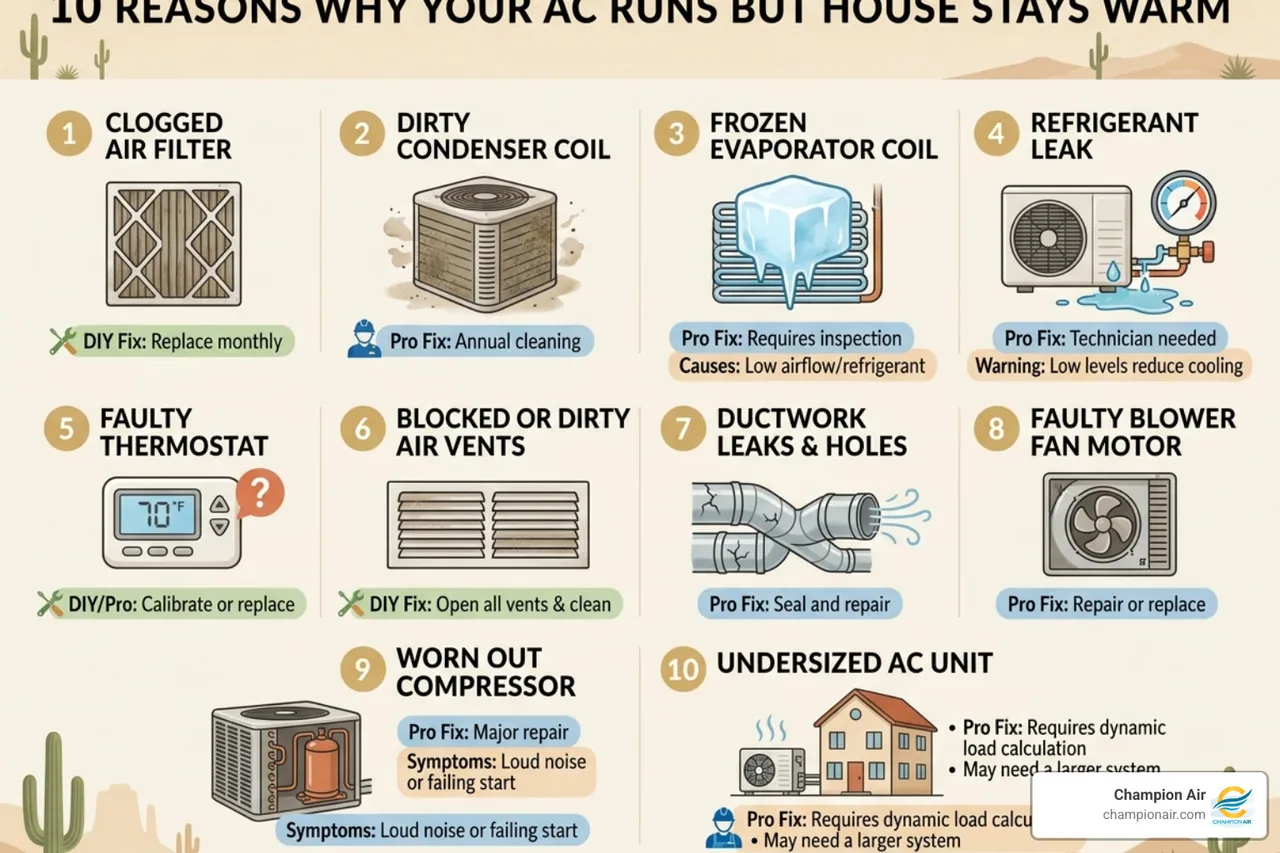
The most common reasons your AC runs but fails to cool your home include:
- Incorrect thermostat settings - Fan set to "On" instead of "Auto," or accidentally switched to "Heat"
- Clogged air filter - Blocks airflow and chokes the entire system
- Dirty outdoor condenser unit - Can't release heat if coils are coated in dust or debris
- Frozen evaporator coil - Ice buildup shuts down heat exchange entirely
- Refrigerant leak - The system runs but has no cooling capacity
- Blocked or leaking ducts - Cool air escapes before it reaches your living space
- Failing capacitor or fan motor - Outdoor unit runs poorly or not at all
- Undersized or aging system - Can't keep up with Arizona's extreme heat load
- Poor home insulation or air leaks - Heat pours back in as fast as the AC removes it
- High outdoor temperatures exceeding system design limits - Most systems are only designed to cool a home 15–25°F below the outside temperature
Here's the key thing to understand: your AC doesn't actually create cold air. It removes heat from inside your home and moves it outside. When any part of that heat-transfer cycle breaks down — whether it's airflow, refrigerant, or the outdoor unit's ability to shed heat — the system keeps running but your house stays warm.
I'm Barry Farah, and as the leader of one of Arizona's largest residential HVAC replacement companies, I've seen every version of ac running but house still warm troubleshooting you can imagine — from a simple dirty filter to a 20-year-old system quietly failing through an Arizona summer. This guide walks you through exactly how to diagnose what's going wrong and what you can fix yourself before calling a technician.
Quick DIY AC Running But House Still Warm Troubleshooting
Before you assume the worst, there are several simple checks you can perform. We often find that a "broken" AC is actually just the victim of a minor setting error or a neglected maintenance task. Learning how to troubleshoot your HVAC system for optimal performance can save you hours of waiting in the heat.
Thermostat Settings: The First Line of Defense
It sounds obvious, but you would be surprised how often a wayward finger or a curious child changes the thermostat settings.
- Mode: Ensure it is firmly set to "Cool." During seasonal transitions in cities like Surprise or Gilbert, it’s easy to leave the system on "Heat" or "Off."
- Temperature: Set the thermostat at least 5 degrees below the current room temperature to ensure the system is actually being called to run.
- Batteries: If the screen is dim or flickering, replace the batteries. A weak thermostat can fail to send the "start" signal to your outdoor unit.
Fan "Auto" vs "On"
This is a major culprit in ac running but house still warm troubleshooting. If your fan is set to "On," the blower motor runs 24/7, even when the AC isn't actually cooling the air. This means between cooling cycles, the system is simply pushing warm, unconditioned air through your vents, making the house feel humid and sticky. Always keep your fan set to "Auto" so it only blows when the cooling mechanism is active. For more on this, check out our guide on common HVAC issues and troubleshooting.
Circuit Breakers and System Resets
If the indoor blower is moving air but the outdoor unit (the condenser) isn't humming, check your electrical panel. A power surge during a monsoon storm in Scottsdale can trip the breaker for the outdoor unit. If it’s tripped, flip it all the way off and then back on once.
- The 3-Minute Rule: If you shut the system off, wait at least three to five minutes before turning it back on. This allows the refrigerant pressures to equalize, protecting the compressor from a "hard start."
Why Your AC Running But House Still Warm Troubleshooting Often Starts with Airflow
Airflow is the lifeblood of your HVAC system. If the air can't move, the heat can't be removed. This is why changing air filters is so important, especially in the dusty Valley of the Sun.
- Clogged Filters: A filter caked in dust, pet hair, or Arizona silt acts like a wall. It forces the blower motor to work harder and reduces the volume of cold air entering your rooms. In May 2026, as we head into the peak cooling season, you should be checking your filter every 30 days.
- MERV Ratings: While high-efficiency filters (MERV 13+) sound great for allergies, they can sometimes be too thick for older residential systems, ironically causing the very airflow restriction you're trying to avoid. We generally recommend MERV 8 to 11 for a balance of filtration and airflow.
- The "Light Test": Hold your filter up to a light source. If you can't see light passing through it, it’s time for a replacement.
Checking the Outdoor Condenser Unit
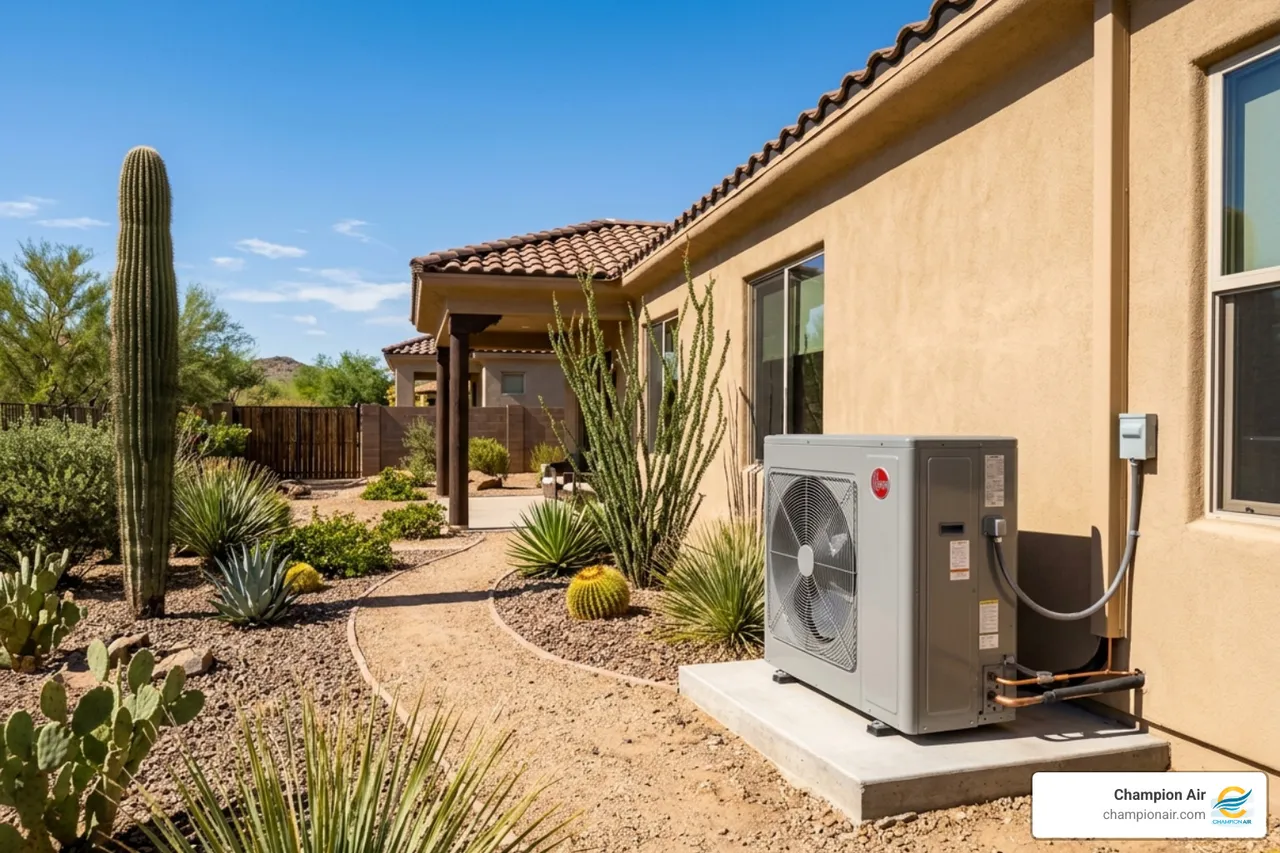
The outdoor unit is where the heat from your home is "dumped." If that unit is dirty or crowded, the heat has nowhere to go, and it stays inside your house.
- Clearance: Your condenser needs at least 2 feet of clear space on all sides. Overgrown desert landscaping, stored boxes, or debris can "choke" the unit.
- Dirty Coils: The metal fins on your outdoor unit can become coated in dirt or grass clippings. You can gently rinse these with a garden hose (low pressure only!) to help the unit breathe.
- Damaged Fins: If the delicate aluminum fins are bent or crushed, it prevents proper heat dissipation.
Identifying Airflow and Ductwork Obstructions
Even if the AC is producing cold air, it might not be reaching you. We often see cases where the system is fine, but the "delivery" is broken.
Supply and Return Vents
Walk through your home in Mesa or Peoria and check every vent.
- Obstructions: Are there rugs, furniture, or heavy curtains blocking the registers?
- Closed Vents: A common myth is that closing vents in unused rooms saves money. In reality, it increases "static pressure" in your ducts, which can lead to leaks and even damage your blower motor. Keep at least 80% of your vents open at all times.
| Issue | Supply Vent Obstruction | Return Vent Obstruction |
|---|---|---|
| Effect | Low airflow in that specific room. | Starves the system of air; causes freezing. |
| Symptom | Room feels stuffy; vent feels "weak." | AC runs constantly; ice on lines. |
| Fix | Move furniture/curtains. | Ensure return grilles are clean and clear. |
Duct Leaks and Insulation
According to the Department of Energy, the average home loses 20% to 30% of its conditioned air through duct leaks. In a hot Arizona attic, that’s air you’ve already paid to cool being dumped into a 150-degree space. If you notice a sudden drop in cooling performance, you might have a disconnected duct. Learning how to fix broken air ducts or having a professional seal them can make a massive difference in your comfort.
Mechanical Failures and Refrigerant Issues
If you’ve checked the filters and the thermostat and the house is still 85 degrees, we might be looking at a mechanical failure.
Refrigerant Leaks
Refrigerant is not like gas in a car; it isn't "used up." It circulates in a closed loop. If your system is low, you have a leak.
- Symptoms: Hissing or bubbling sounds, a sweet chemical smell, or lukewarm air coming from the vents.
- The Danger: Low refrigerant causes the system to work harder, eventually leading to a burned-out compressor. Check out the signs your air conditioner is low in Freon to see if this matches your situation.
Failed Capacitors and Fan Motors
The capacitor is like a large battery that gives your AC motor a "kickstart." In the extreme heat of Buckeye or Chandler, these are the most common parts to fail. If you hear a humming sound from the outdoor unit but the fan isn't spinning, you likely have a dead capacitor. If the AC fan is not spinning, the heat cannot be moved out of the refrigerant, and your cooling stops immediately.
When Your AC Running But House Still Warm Troubleshooting Indicates a Failing System
Sometimes, the issue isn't a broken part; it’s an old one. AC units in Arizona typically have a lifespan of 10 to 15 years. After a decade of 115-degree days, the mechanical efficiency of the compressor begins to drop.
An undersized unit is another common problem. If you’ve added a room or enclosed a patio in your Phoenix home, your old AC might simply be too small to handle the new square footage. If your system runs 24/7 and the temperature only goes up during the day, it’s a sign the unit is overmatched.
Frozen Evaporator Coils and Drainage Problems
It seems counterintuitive, but your AC can actually freeze solid in the middle of a Tempe summer. This happens when the evaporator coil (the part inside your house) gets too cold because air isn't moving over it, or because the refrigerant level is low.
- Signs of Freezing: A visible block of ice on the copper lines or water pooling around the indoor unit.
- What to do: Turn the system to "Off" or "Fan Only" immediately. This allows the ice to melt. Running a frozen system can lead to "slugging," where liquid refrigerant enters the compressor and destroys it.
- Drainage: If you see water dripping from your air conditioner, it could be a clogged condensate drain. Most modern systems have a float switch that will shut the AC off entirely if the drain pan gets too full, preventing a flood in your home.
Environmental Factors and System Limits in Arizona
In Arizona, we have to respect the laws of thermodynamics. Even a perfectly functioning AC has limits.
The 20-Degree Differential
Most AC systems are designed to create a 15–25 degree difference between the outdoor temperature and the indoor air. If it is 115°F in Phoenix, and your AC is holding the house at 80°F, it is actually performing quite well. Expecting a system to hit 68°F when it's 120°F outside is often asking for more than the equipment was built to do.
Inertial Heat and Thermal Mass
If you turn your AC off while you’re at work and the house reaches 95°F, it will take hours to cool back down once you get home. This is "inertial heat." Your walls, furniture, and flooring have all absorbed that heat. Even if the AC is blowing 55-degree air, it has to fight the heat radiating from your own couch and drywall. This is why we often discuss how long an AC should run in Arizona — during a heatwave, "steady and slow" is better than turning it off and on.
Solar Gain and Insulation
If your AC is running but the house is warm, look at your windows. Solar heat gain through glass can account for up to 30% of your cooling load. Using blackout curtains or solar film can take a massive weight off your AC’s shoulders. Similarly, if your attic insulation has settled or thinned over the years, heat is pouring through your ceiling faster than your AC can remove it.
Frequently Asked Questions
Why is my AC blowing air but the house isn't getting colder?
This is usually a sign that the "delivery" part of the system (the fan) is working, but the "cooling" part (the compressor or refrigerant) is not. Check your outdoor unit to see if it’s running, and inspect your air filter for clogs.
Can a dirty filter really stop my house from cooling?
Absolutely. A dirty filter restricts airflow, which can cause the evaporator coil to freeze. Once the coil is encased in ice, it can no longer absorb heat from your home, and the air coming out of your vents will turn warm.
Should I turn off my AC if it's running but not cooling?
Yes. If the air coming from your vents is warm, or if you see ice on the lines, turn the system off. Continuing to run a malfunctioning AC can cause permanent, expensive damage to the compressor or the blower motor.
Trust the Local Experts at Champion Air
When ac running but house still warm troubleshooting reaches the limit of what you can do safely, it’s time to call in the professionals. At Champion Air, we’ve been serving the Valley since 1982, providing award-winning service to homeowners in Scottsdale, Phoenix, Mesa, and throughout the surrounding areas.
Whether you're in Anthem, Chandler, or Surprise, our licensed technicians are available 24/7 for emergency repairs with no overtime charges. We understand that in Arizona, a working air conditioner isn't a luxury — it's a necessity. We specialize in everything from quick capacitor swaps to full high-efficiency system replacements.
Don't spend another minute sweating in your own living room. Schedule your expert Arizona cooling service today or visit our Professional HVAC Repair Services page to see how we can restore your home to the sanctuary it should be. At Champion Air, your comfort is our mission.
About the Author
Champion Air
More Articles
View All Posts
Ready to Get Started?
Whether you need a repair, maintenance, or a new installation, our expert team is here to help.